Bangkok is large and modern, and yet somehow shabby in its modernity. It feels different from everything we’ve seen so far in Southeast Asia. It feels like it could be anyplace, anywhere in the world. But we haven’t been here long, and haven’t really moved far enough from the hotel to make a fair judgement.
There are about 9 million people living in Bangkok: more than twice the population of British Columbia. Ho Chi Minh City has a larger population, but it didn’t feel as much like a big city. There are fewer motor scooters and tuk-tuks, more cars, vans and trucks. There are people who are apparently homeless — something we hadn’t really seen in Vietnam or Cambodia.
I was sad to leave Siem Reap this morning. And sad to say goodbye to some of our fellow travellers, who had other destinations to move on to. Not to mention Yang, our “chief experience officer,” who did such an excellent job with us all.
What I didn’t feel was the familiar sense of anticipation that I had upon leaving Hanoi, Hué, Hoi An, Ho Chi Minh City, and Phnom Penh. Overall, it felt more like an ending than a transition when we boarded the plane.
We have no real plans here in Bangkok, other than to see some sights, do a little shopping, and eat some good food. We won’t be here for long, either. Just a couple of days, then we’re flying back home.
But I don’t want to jump ahead too much. Let’s see what tomorrow brings.
Today is Adele’s birthday, and it’s been a pretty good one so far, I think. She’s currently at a spa down the street from our hotel getting a much-deserved pedicure as I begin writing.
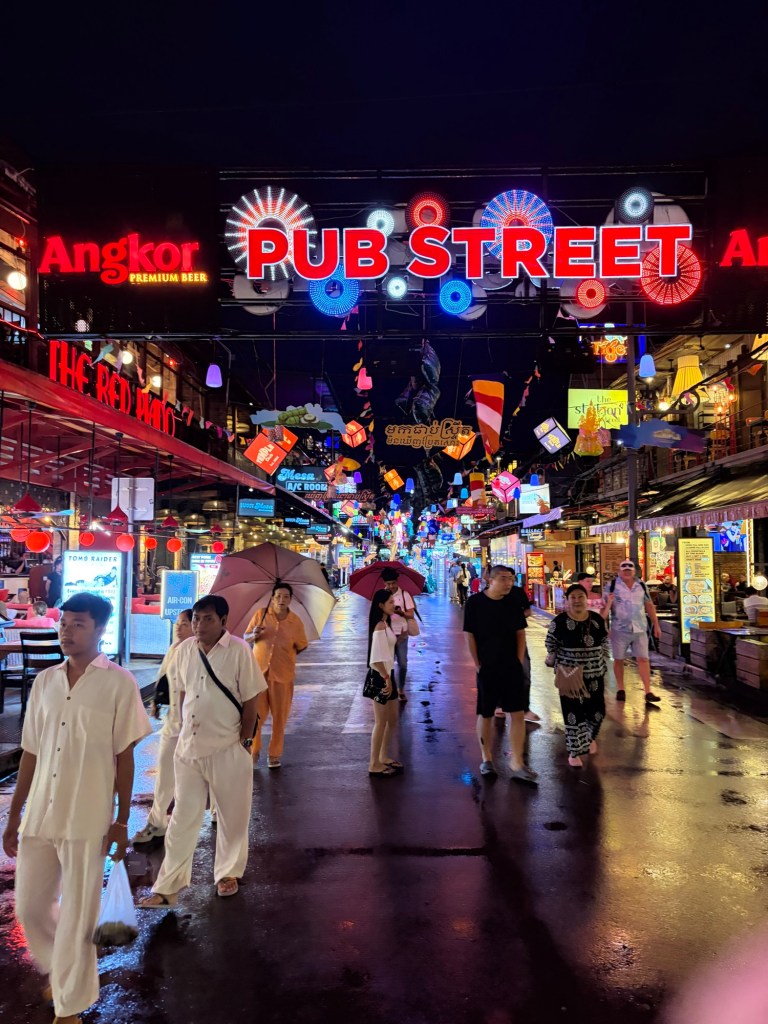
I don’t think I’ve discussed the hotel here in Siem Reap. The Angkor Aurora is a very nice boutique hotel, located on a quiet street, but still close to everything. We’re a short walk from the Night Market, and from Pub Street. The room is large, the king-size bed comfortable, and the air-conditioning more than up to the task. Breakfast is included, and is quite good. They have a happy hour in the lobby from 2-5 pm.
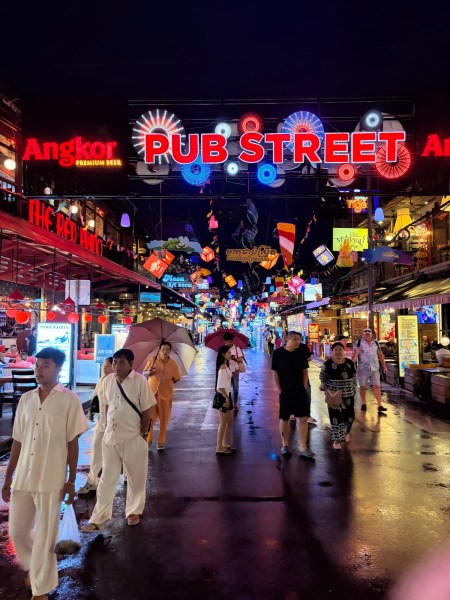
Pub Street — about a 10 minute walk from our hotel
Today we got up at a relatively normal time, feeling rested after an early night. The plan was to visit yet another temple, followed by a visit to Kampong Luong floating village. But Yang decided it might work better if the order was reversed, and I think he was right about that.
We boarded the bus for the hour-and-change drive out to the pier where we would catch the boat for the tour. we had the same local guide, JB, as we had for the tours of Angkor Wat and the Jungle Temple the previous day. He grew up about halfway between the hotel and the pier, and was able to tell us a lot about the area, its history, how people live here, and about the lake and canal we’d be visiting.
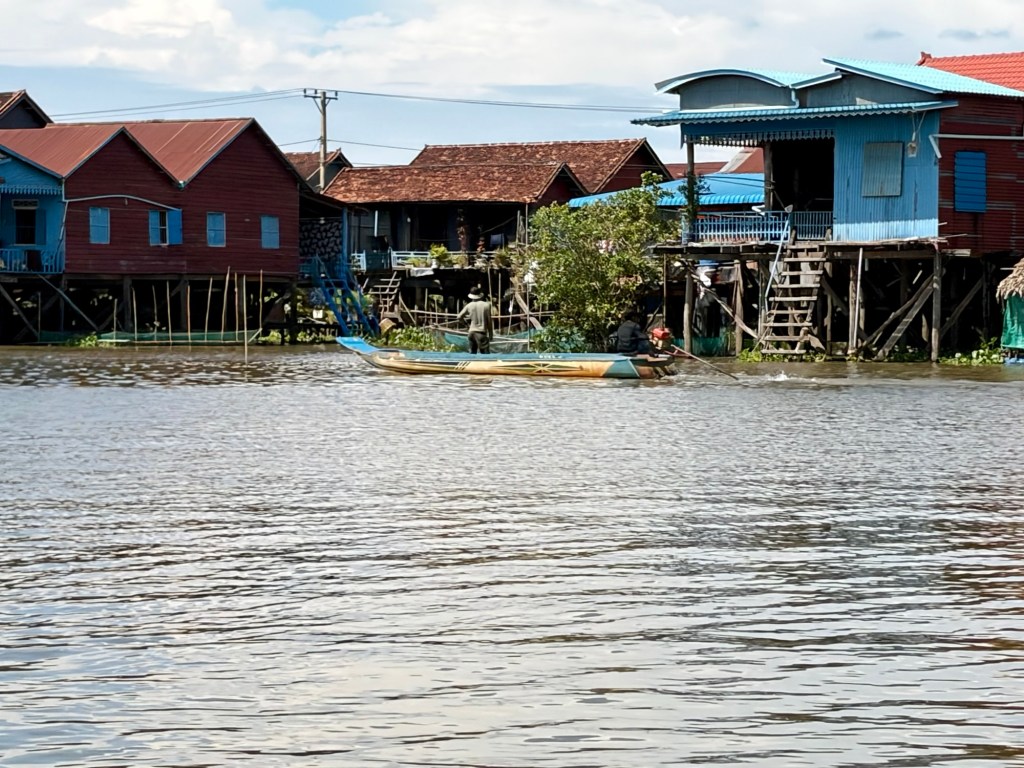
A fisherman on his boat close to the stilted houses that line the canal banks
As we motored along the canal, he told us how during the rainy season that’s just ending, the water is quite high, and people use canal boats to navigate the villages that line the banks. In the dry season, though, the canals dry up, and the lake they connect to shrinks significantly, both in area and depth. The water recedes inward more than a kilometre, and what was more than seven metres deep becomes no more than one — or about hip-deep. When the water is high, people fish; when it’s low they grow rice and long beans.
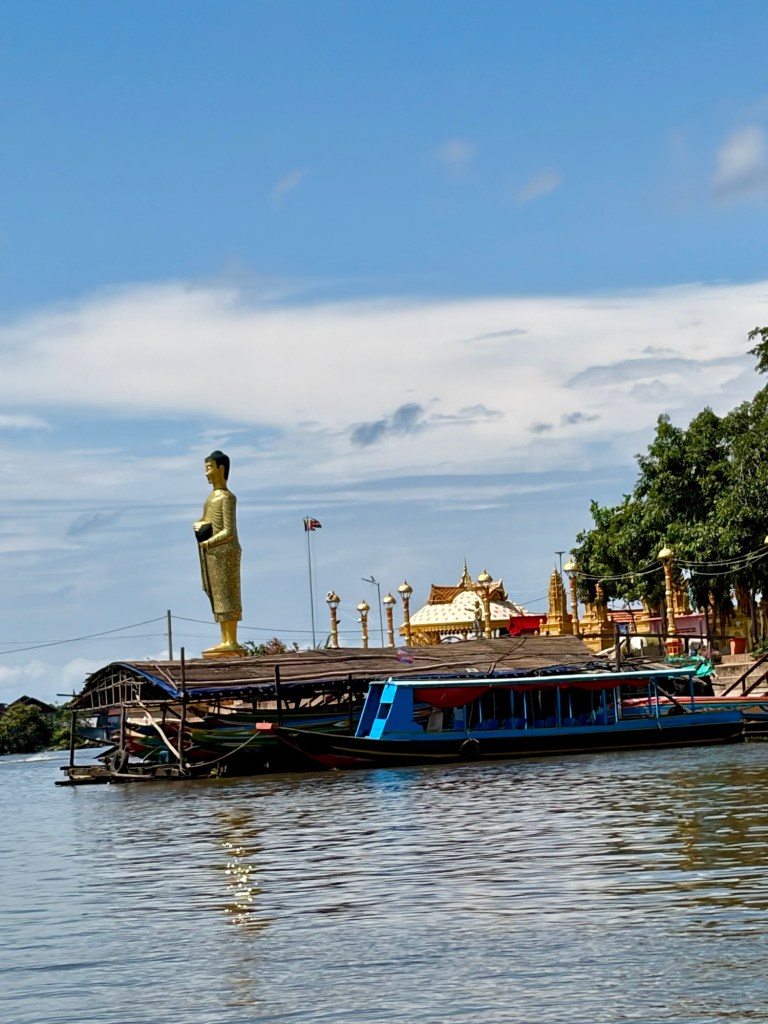
There are five Buddhist monasteries along the canal we travelled, and one Catholic Church. We stopped at the largest of the monasteries to tour the grounds before continuing to the lake. JB explained that many children from poorer families become monks to receive free education, food and accommodation. It sounds like a hard life, given the 227 rules they need to follow. However, they can leave the monastic life at any time, and I suspect many do.
Standing Buddha at the entrance to the grounds of the monastery near Kampong Kleong
Returning to the boat, we made our way to Tonlé Sap, one of the largest freshwater lakes in Southeast Asia, fed mainly by the Mekong River, before turning ourselves around and heading back past the mangroves and floating houses, the fishing boats and stilt houses, to the pier and our bus.
We decided lunch would be a good idea before heading to the temple du jour, and we stopped at a nice restaurant located in JB’s hometown. The food was good, and the setting was beautiful, open air but covered, with ceiling fans to keep us comfortable. Afterwards, Adele decided she wasn’t really up for another walking tour of a large temple, especially in the heat of the day, so we got dropped off at the hotel early, and found a nearby spa for Adele.
We met up with the group again for one last dinner together. There are several of us flying to Bangkok tomorrow afternoon, but several others are dispersing to Danang, or to Singapore, or elsewhere in Asia.
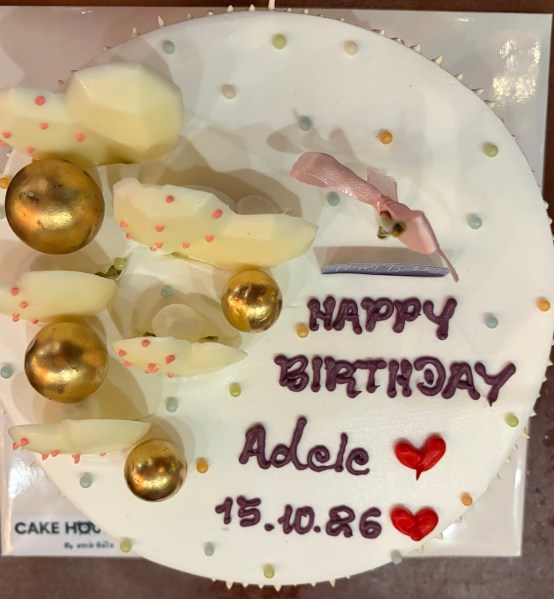
We went to quite a nice restaurant near Pub Street, and over the course of the meal talked about where we’d been together, where we were going next, and what waited for us at home. We drank cocktails and ate decadent, yet inexpensive food. Yang even arranged for a birthday cake for Adele.
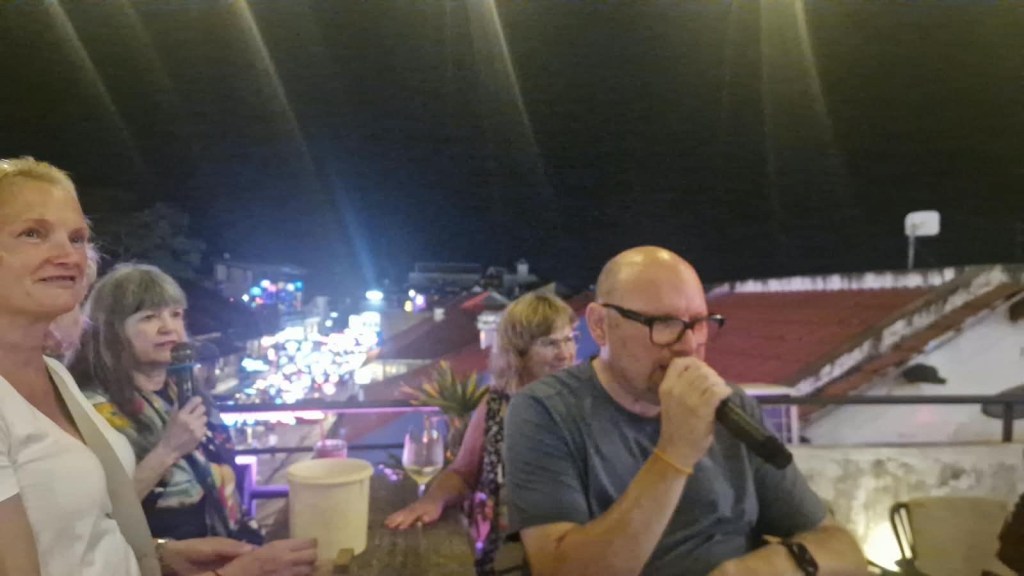
A half dozen or so of us went with Yang to a rooftop karaoke bar. More drinks, games of Jenga, and at Yang’s request, some karaoke (although I was the only one who sang anything).
Singing “Make It Wit Chu” for the birthday girl
Now it’s time to sleep. Tomorrow will come soon, and with it a farewell to Siem Reap and Cambodia, a beautiful city and country we won’t soon forget.
My alarm jolted me awake at four, and grumbling I made my way across the room to see what the weather looked like. I’ve never wanted rash badly in my life, since then I could go back to sleep. But it was dry outside, so I woke Adele and started getting myself ready. We had to be downstairs at quarter to five to board the the bus to Angkor Wat. There was no time for breakfast, or even coffee before leaving, if we wanted to be there to see the sunrise.
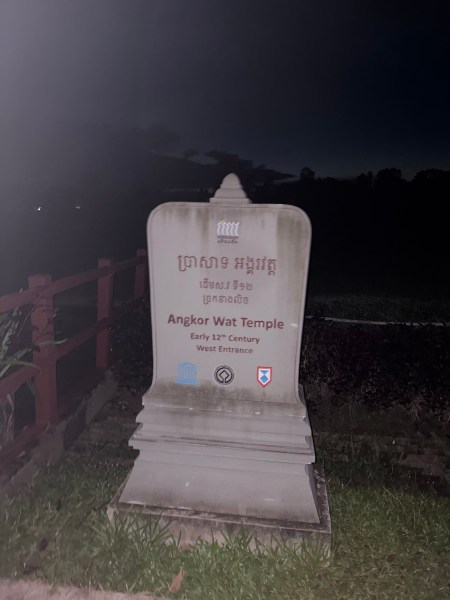
And so after a short bus ride, we began to trek through the dark to a vantage point where we could take in the gradual illumination of the temple. According to Yang, the chances of actually getting to see the sunrise at Angkor Wat are vanishingly small. In twenty years, he said he’s only experienced it a handful of times.
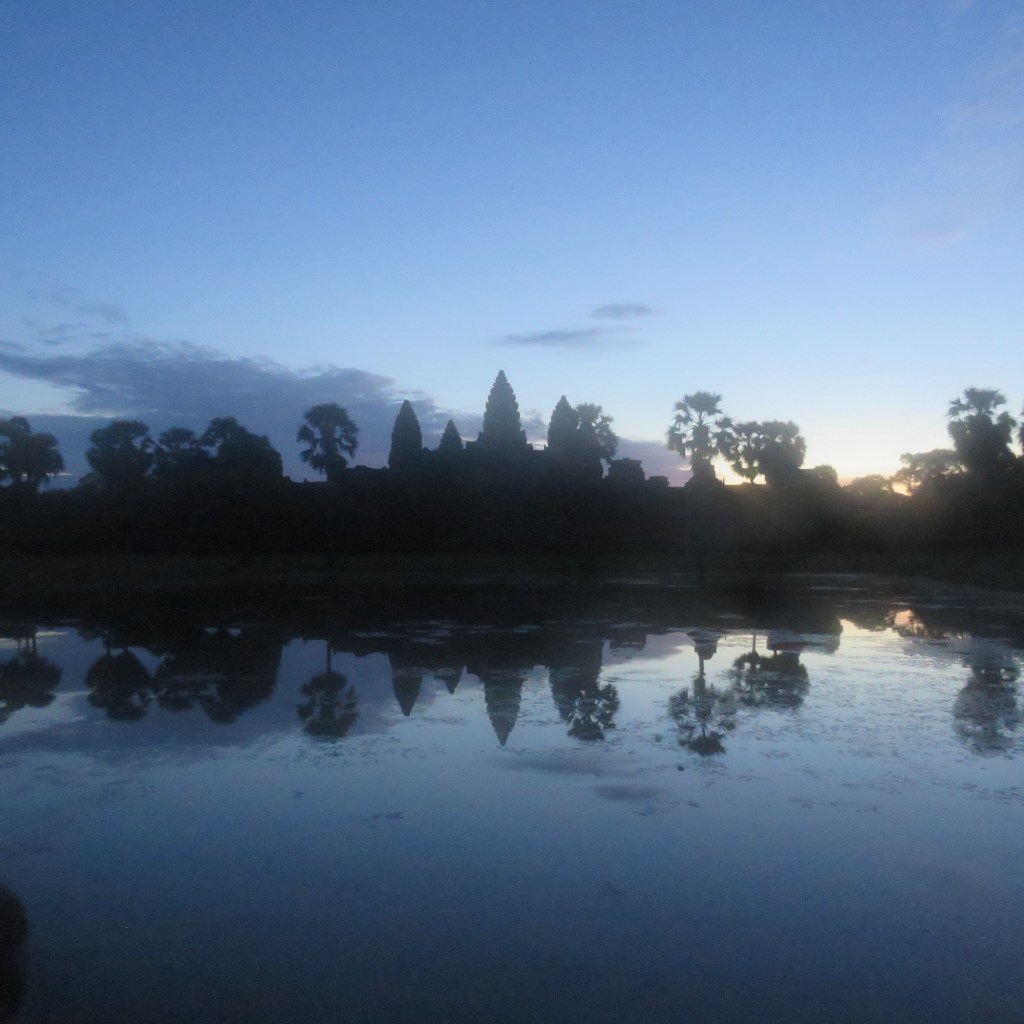
We trudged through the dark along a worn stone pathway, across a stone bridge, and between sandstone buildings that had once been libraries. As we walked, the sky began to brighten little by little, almost imperceptibly at first, and the outlines of the old temple began to stand out against the background of the sky. At the urging of our guide, we took up positions near the edge of a deep pool, along with dozens of other tourists. All of us with cameras at the ready.
The silhouette of Angkor Wat against the pale morning sun
After everyone had their fill of taking the same picture again and again, but with slightly better lighting as the minutes ticked past, we met at a small café on the grounds for coffee and breakfast. Cats and dogs came to visit us, as did souvenir hawkers.
For the next couple of hours, we explored the grounds and buildings of Angkor Wat, once the largest Hindu temple in the world, although it has converted over time to Buddhism. The temple was built in the twelfth century, but was disused and enveloped by the jungle when the Cambodian capital moved from Siem Reap down to Phnom Penh. It currently houses two Buddhist monasteries.
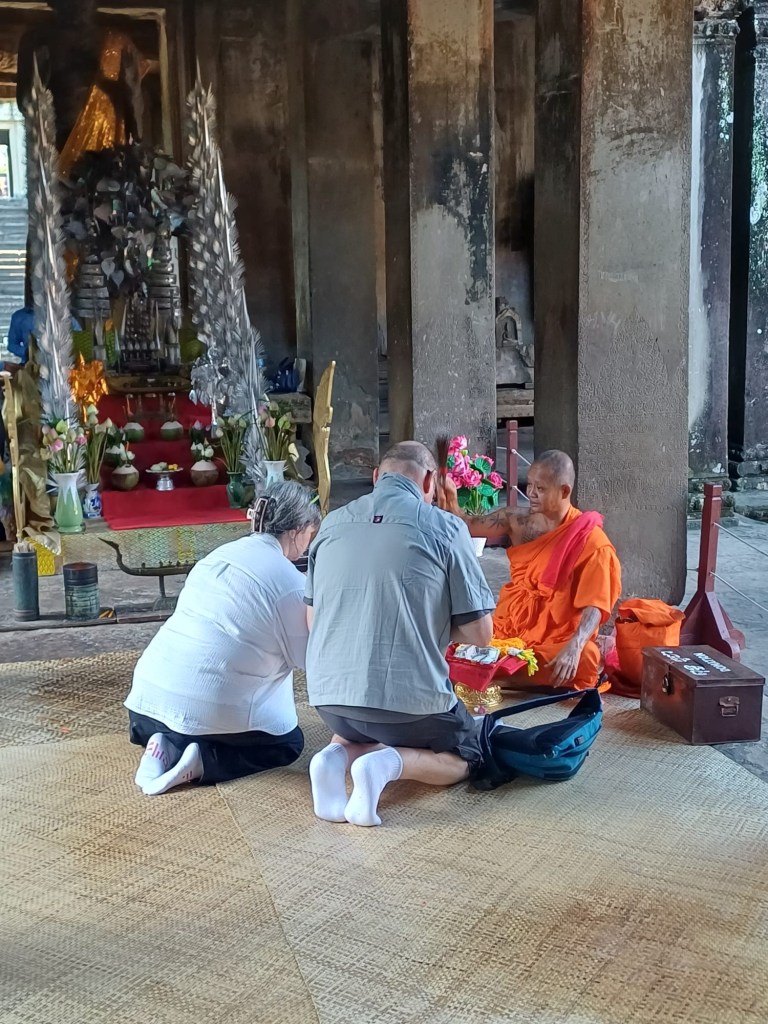
Getting blessed in Angkor Wat
In the main building, Adele and I took the opportunity to receive the blessing of a Buddhist monk. For a nominal fee, he used a lotus flower to splash us with water from a brass bowl while chanting. And no, I didn’t sizzle at the touch of the holy water.
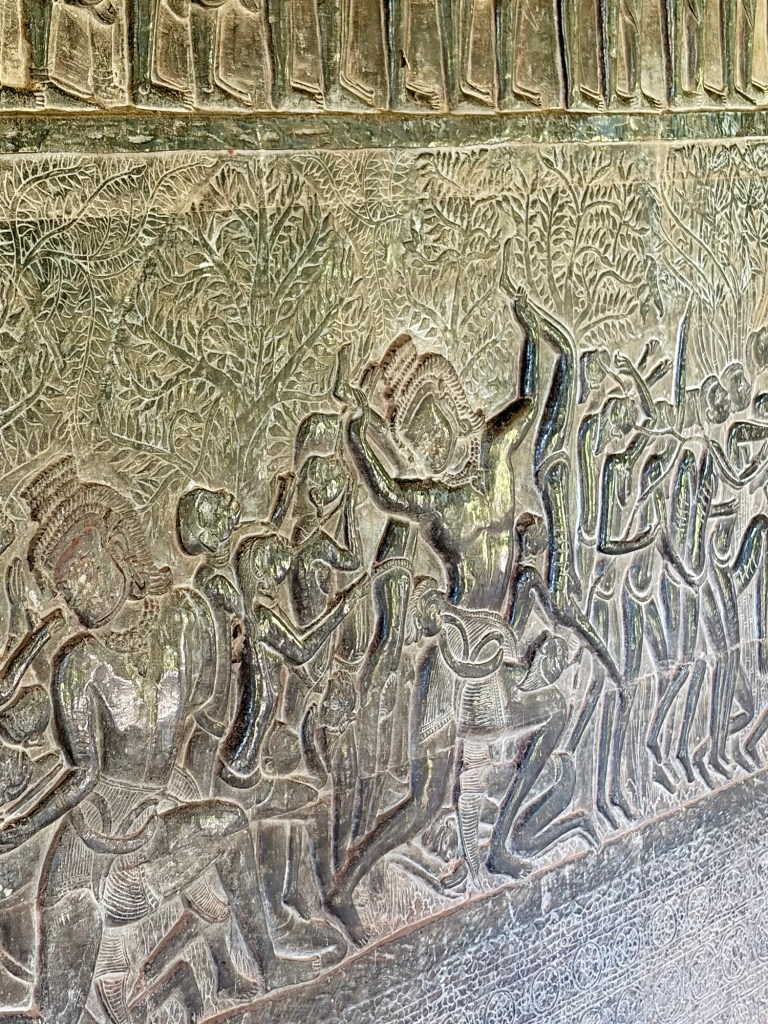
Detail from one of the walls inside Angkor Wat
Overall, it was worth going to Angkor Wat, although I would still prefer to have slept a little longer.
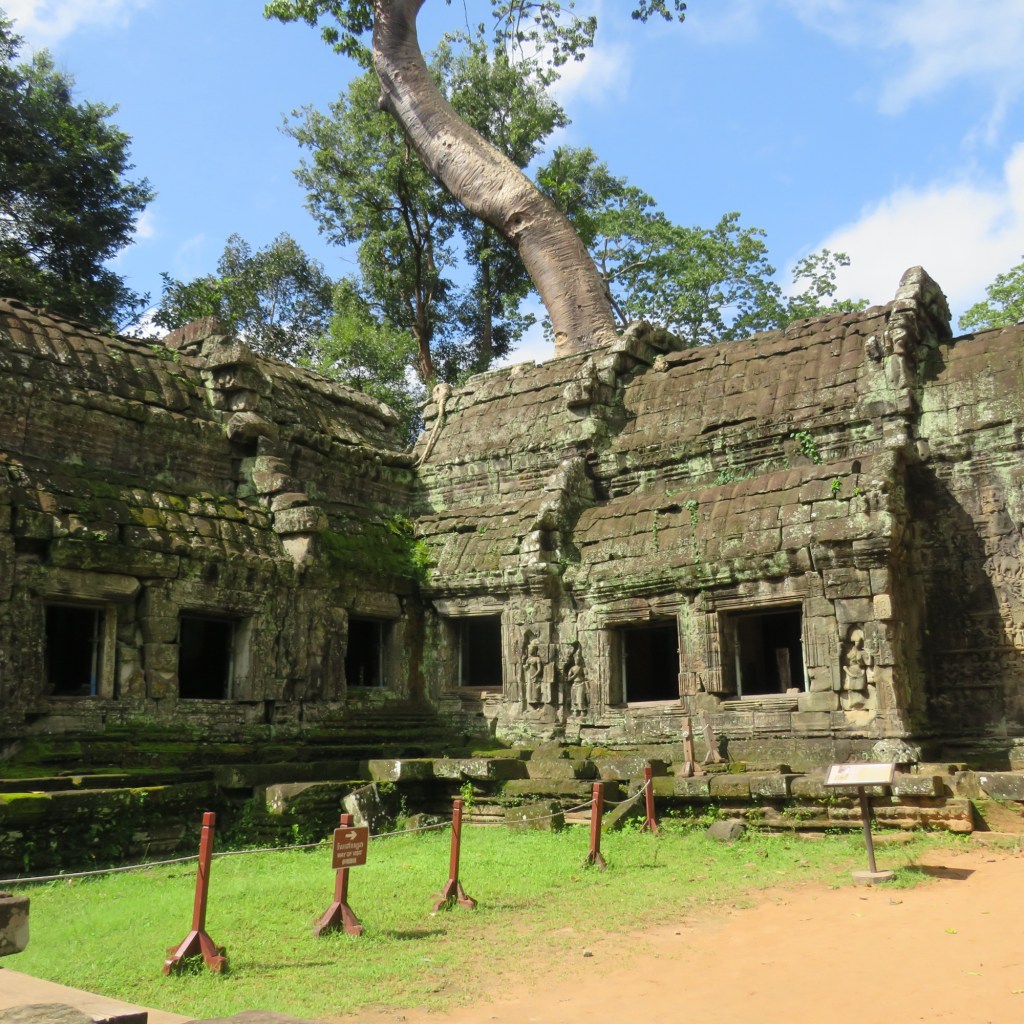
Soon, though, we were back on the bus and headed to the next temple, To Prohm, which had also become overrun by the jungle. In fact, there are several buildings with trees growing through, or out of them. It was fascinating as well, but our tiredness and the humidity somewhat dampened (as it were) our enthusiasm.
One of the buildings at the Jungle Temple
There’s not really much more to relate about today. Tomorrow we visit another temple, though thankfully not so early, followed by a floating village.
Today was mainly spent on the bus. We set off shortly after breakfast, and arrived at our hotel close to four in the afternoon.
The rain that had fallen steadily through the night, and was still falling at breakfast, subsided by the time we were boarding the bus. We drove through Phnom Penh and its outskirts, moving from close-built neighbourhoods of stucco and brick and concrete buildings through areas of sporadic structures made of metal poles and corrugated aluminum walls and roofs. Scooters parked in the yawning doorways, and folding tables and chairs visible behind them. Men sitting smoking and talking as they watched without interest as the bus passed. Cows or buffalo grazing aimlessly along the verge.
We passed small villages and towns. Arched gateways at the entrance to roads that seemed to lead nowhere.
The weather shifted from sun to cloud then rain, and back again. The light rose and fell as we drove on. I watched scooters bearing one, two, sometimes three people in the oncoming lane ploughing through flooding streets, the water nearly reaching their feet, wearing translucent ponchos in green, yellow, red and orange, some with large polka dots.
We made stops to get coffee, have lunch, and get our passes to visit Angkor Wat tomorrow, before ultimately arriving at the Angkor Aurora Hotel in Siem Reap. It’s a very nice, small hotel, and well appointed. The room is large, with a comfortable king-size bed.
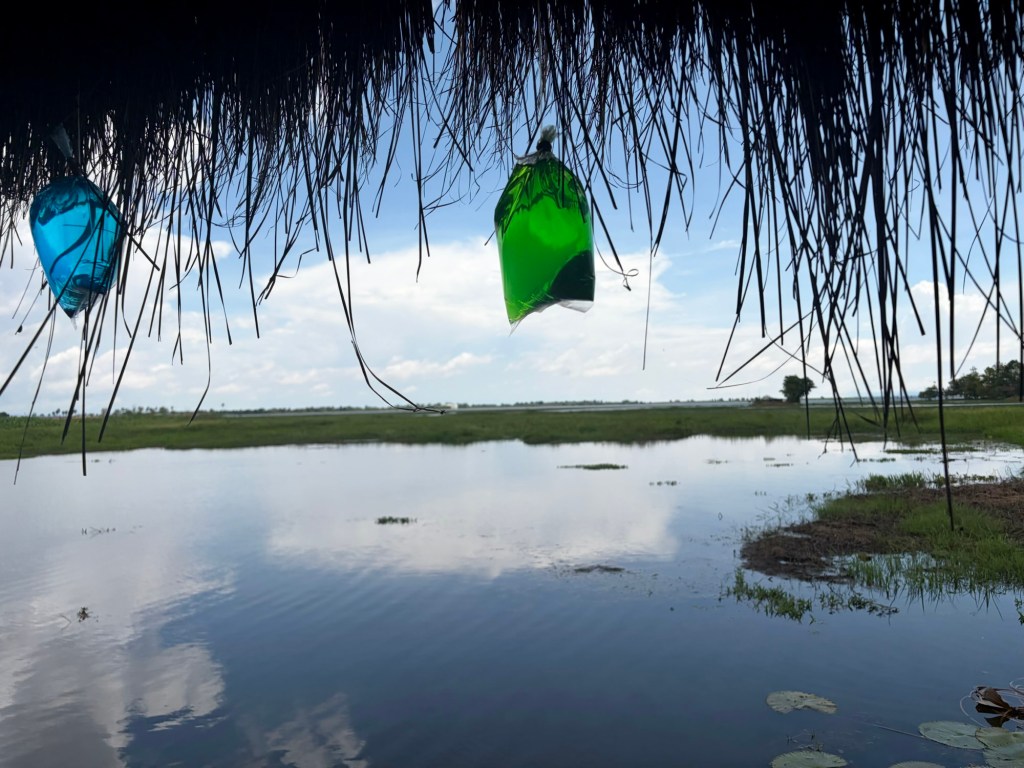
View from our lunch table
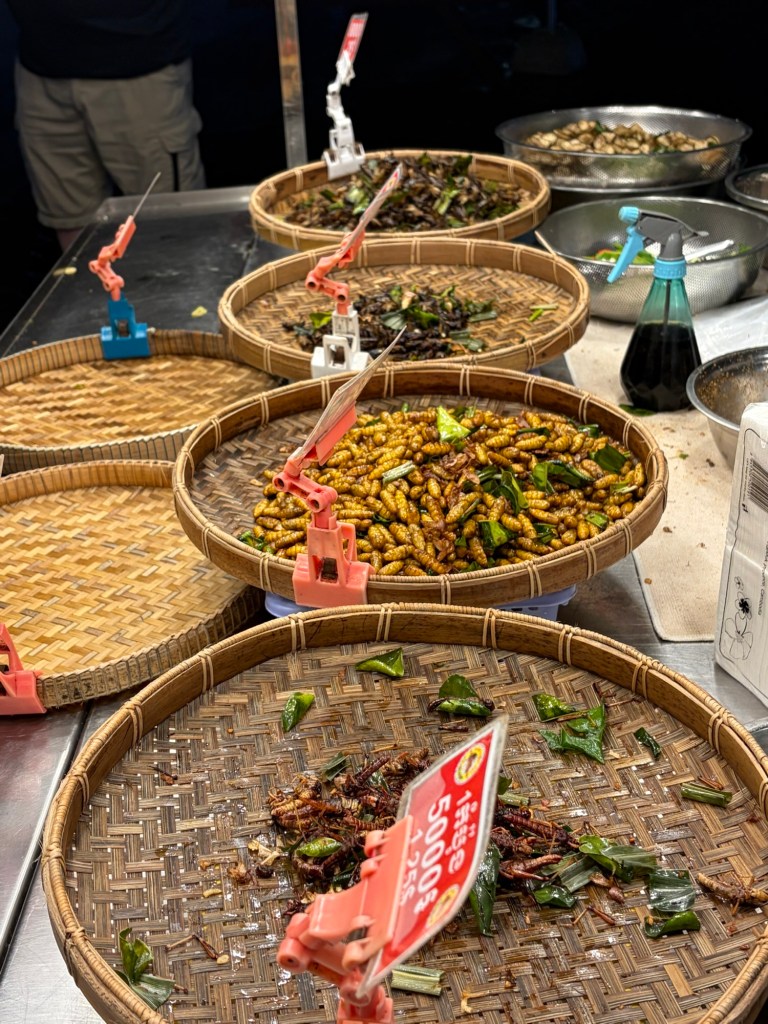
After settling in, Yang took us all for an orientation walk through the neighbourhood and over to the night market, where we sampled fried crickets, “water beetles” (i.e., cockroaches) and coconut worms. Local delicacies, according to Yang, and really not all that bad once you get past the idea of it. We went as a group for dinner at a nice little restaurant not far from Pub Street.
Fried insects and grubs
After dinner Adele and I, along with a few others, attended the Phare Circus, which was really fantastic. If you ever find yourself in Siem Reap, I I highly recommend seeing a show.
Now it’s time for sleeping. We need to be up super early to hopefully see the sunrise at Angkor Wat. More tomorrow.
Today was hard. We set off early to visit S-21, the infamous Khmer Rouge prison, and then to the genocide museum at Choeung Ek, a former Chinese graveyard, better known to many as the Killing Fields.
The Khmer Rouge only held power in Cambodia for a short time, from 1975 until they were displaced by the Vietnamese in 1979. Their stated goal was to create a classless, agrarian society, not dependent on money, commerce or trade. They were led by the infamous dictator Pol Pot.
When the Khmer Rouge entered Phnom Penh, they were initially greeted with celebration. That changed very quickly, though. They ordered the city to be emptied over a span of three days. People were forced to wear all black clothing, and to leave all their belongings behind. Regardless of what they had done before, they would now work as labourers on collectivist farms. Families were separated, with boys, girls, women and men all living and working in groups divided along lines of age and gender.
Intellectuals, doctors, lawyers, engineers, teachers, politicians , policemen, soldiers and officials connected to the old regime were taken to S-21, a former school now transformed into a prison, and a place of torture. They were made to confess their alleged crimes against the revolution, and to make lists of their families: wives, children, parents, siblings, who would in turn be rounded up, too. When their confessions and lists were completed, they were executed.
Getting people to confess often required torture. I will spare you the list of sadistic methods and tools. It is enough to know that no one was spared: not infants or children; not mothers, or soon-to-be mothers; not the elderly.
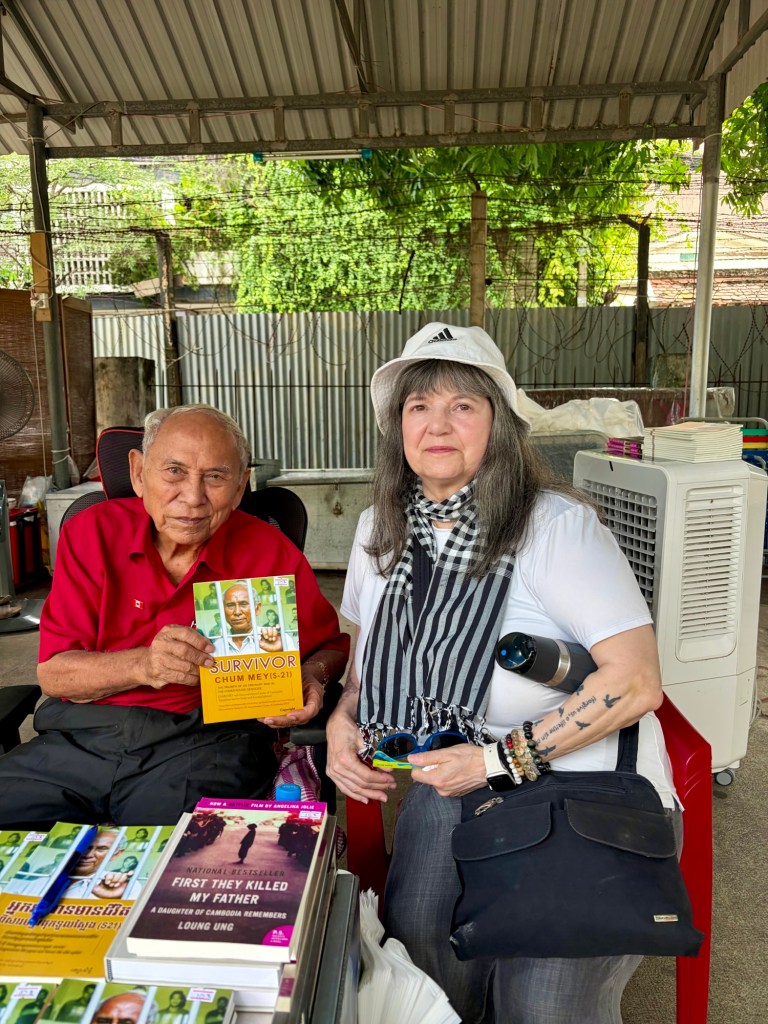
Adele with Chum Mey, one of the last survivors of S-21. He wears a Canadian flag pin on his shirt, which was given to him by former Prime Minister Justin Trudeau
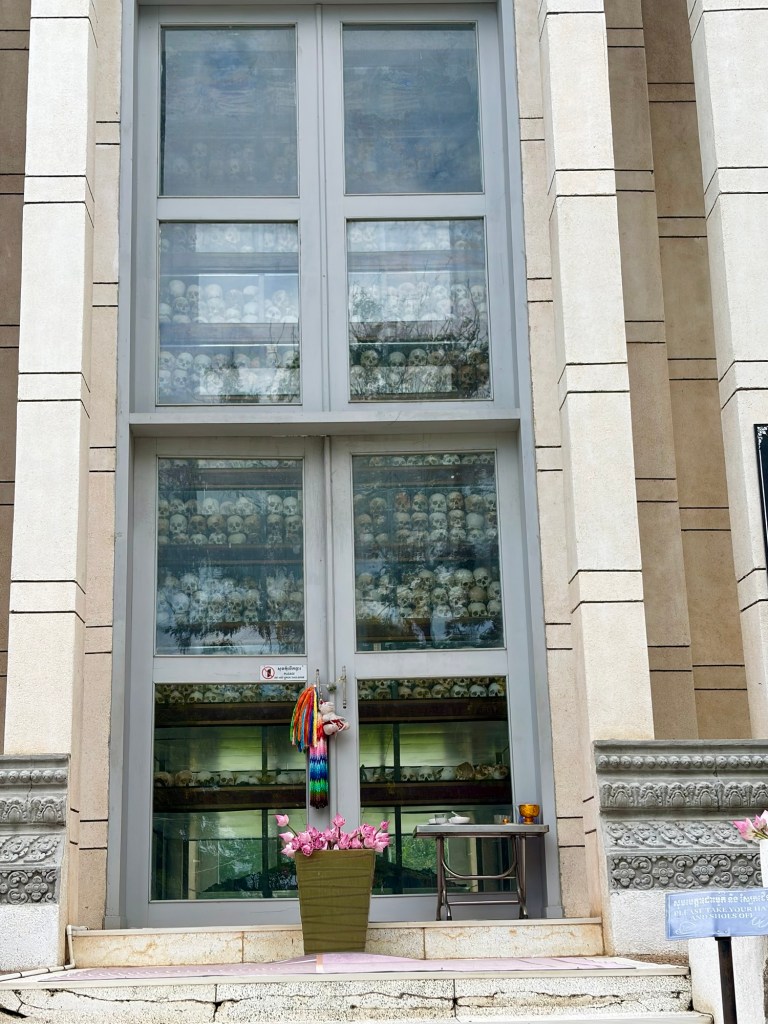
Eventually, there were too many bodies to keep burying them outside the prison walls, and so the Khmer Rouge appropriated an old Chinese graveyard outside Phnom Penh, called Choeung Ek.Prisoners were transported from S-21, blindfolded and with their hands bound behind their backs, on trucks to the killing fields, where they were slaughtered and buried in mass graves. At first, 20-30 a day, but later more than 300 a day. Nearly 9,000 skulls have been exhumed since 1979, when all this was uncovered by the Vietnamese.
A monument at Choeung Ek containing the remains of victims exhumed there
I will not detail the methods of execution. Suffice it to say they were as barbarous as the methods of torture the victims had already suffered.
One of the mass graves contained more than 450 bodies. Another primarily contained women, children and infants. Yet another held the decapitated bodies of military officers from the old regime. In all, the Khmer Rouge are estimated to have killed millions of Cambodians in the span of four short years. One hopes the guilty have been ground under the karmic wheel.
By the time we left Choeung Ek, I was emotionally exhausted. Between this and our visit to the war remnants museum, I am deeply disturbed by how easily ordinary people can be made to do evil things.
Thank goodness Cambodia has changed. Although still not really a free or democratic country, at least people are no longer being slaughtered for the crime of having a relative who worked as a school teacher.
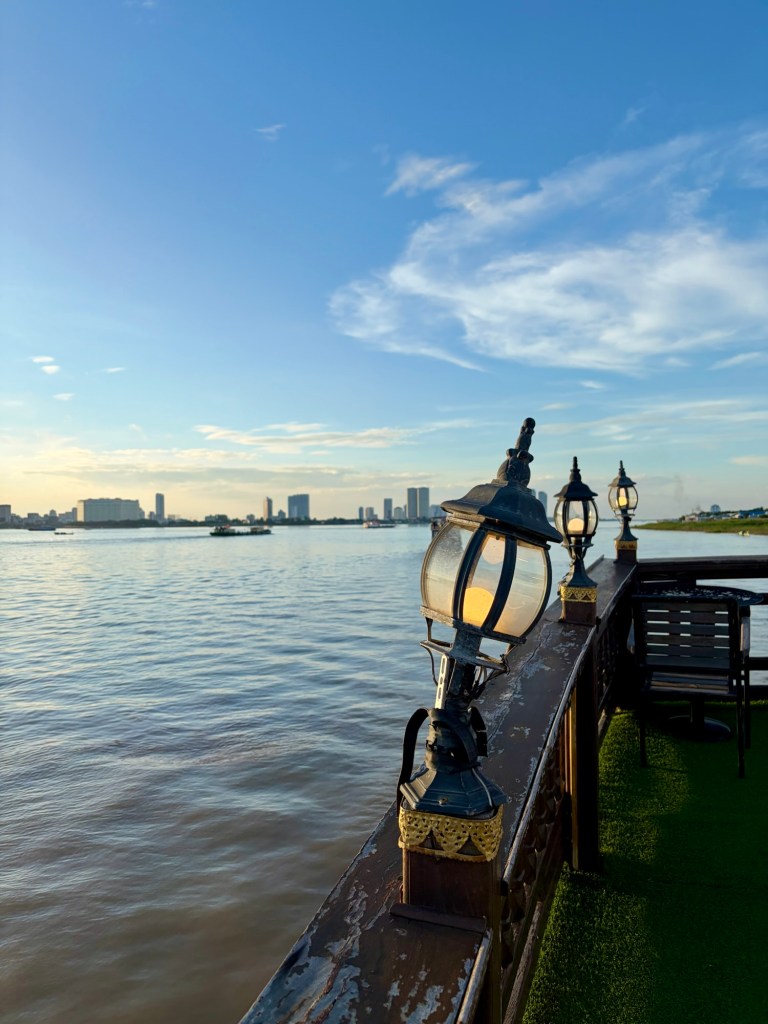
Thankfully, too, there was more to the day that wasn’t nearly so sombre. In the evening we took a sunset river cruise, and spent time talking, drinking and listening to music as we sailed in a large circuit beginning and ending near the royal palace.
Sailing into the sunset on the Mekong River
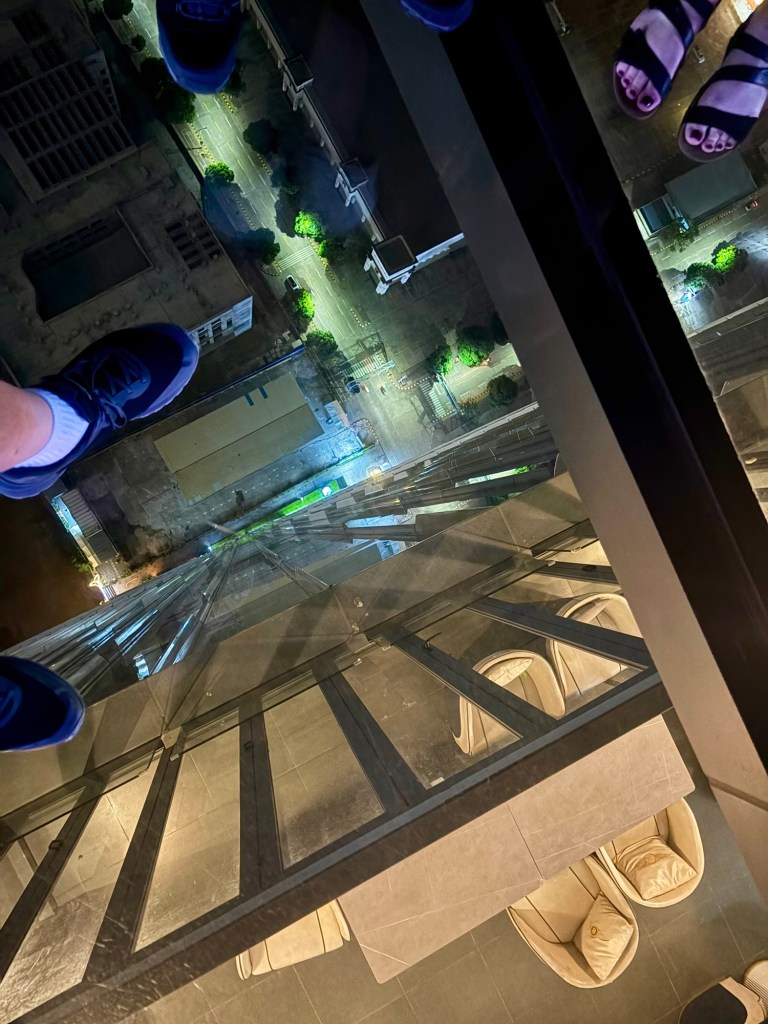
Afterwards, we all made our way to the La Vida Sky Bar, located atop the tallest building in Phnom Penh. Cooler than any lounge I’ve visited in North America, it even has a glass walkway so you can look down at the street 48 floors below. The music was decent, and it was still happy hour, so there were 2-for-1 cocktails on offer.
Looking down through the glass walkway at the Sky Bar
Once the evening thunderstorms rolled in we piled back into our tuk-tuks and came back to our decidedly less fancy hotel. Tomorrow we have a long drive to Siem Reap.
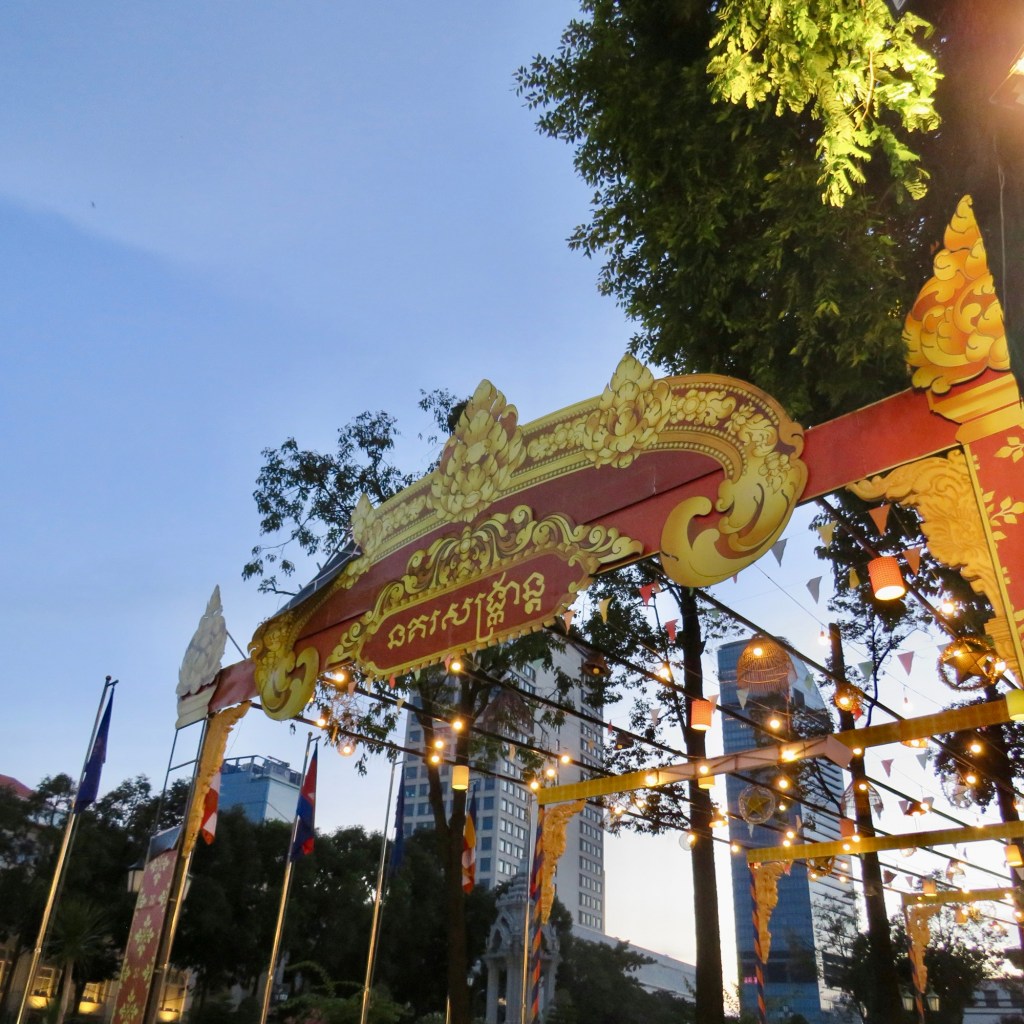
We arrived in Cambodia in the midst of a national holiday. Pchum Ben is a sacred Buddhist holiday, which lasts for 15 days. The final three days are public holidays, and tomorrow is the last day of the festival. This means a lot of businesses are closed, which is too bad, as there are several musical instrument shops nearby.
The streets are decorated for celebrating Pchum Ben
But let’s back up a little.
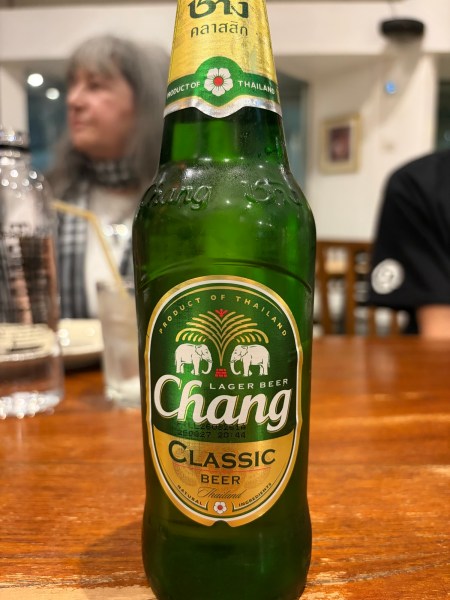
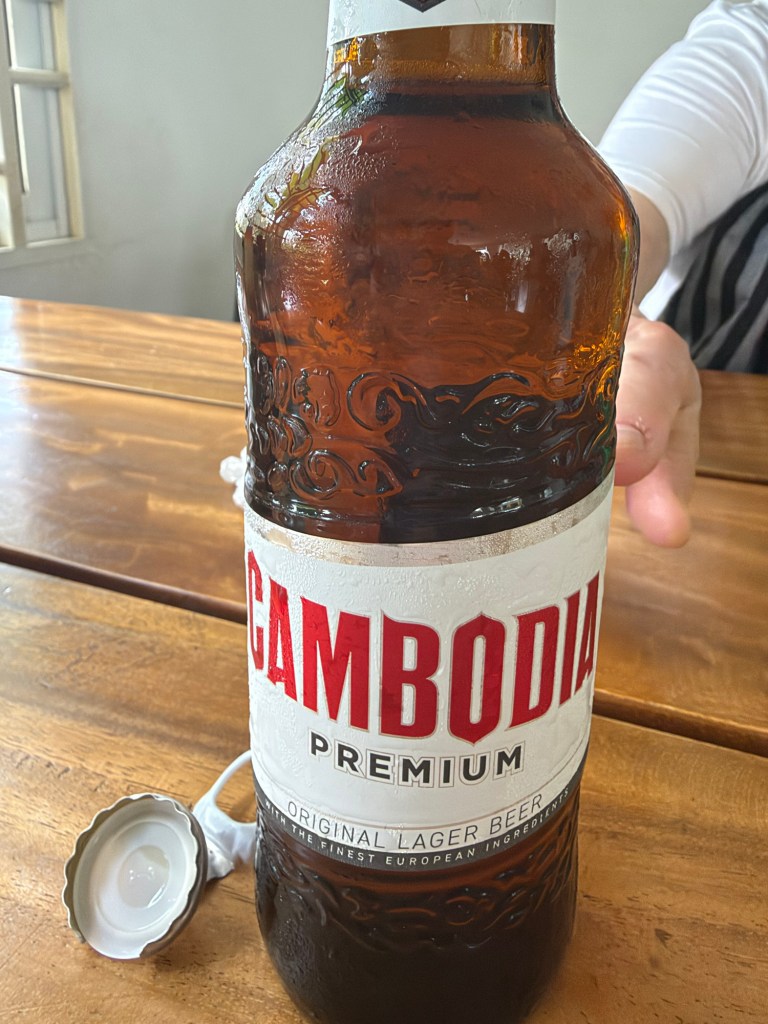
We passed through immigration and customs without any problems, and boarded a smaller bus to Phnom Penh. It’s a fairly long drive, so we stopped for lunch at a roadside café along the way. The food was tasty, and I had my first Cambodian beer. The bill was $12USD for the two of us, which seems crazy cheap. I can’t get lunch for myself for much under $20 back home.
My first local beer
It was another two and a half hours to Phnom Penh. Rice paddies not yet ready for harvest, cows grazing near the side of the highway. Billboards advertising beers, energy drinks, 5G phone plans and Krud Cola. Simple buildings made of corrugated metal held up by metal frames. Occasionally some ornate statuary forming gates to properties — enormous plaster elephants adorned with bight paint.
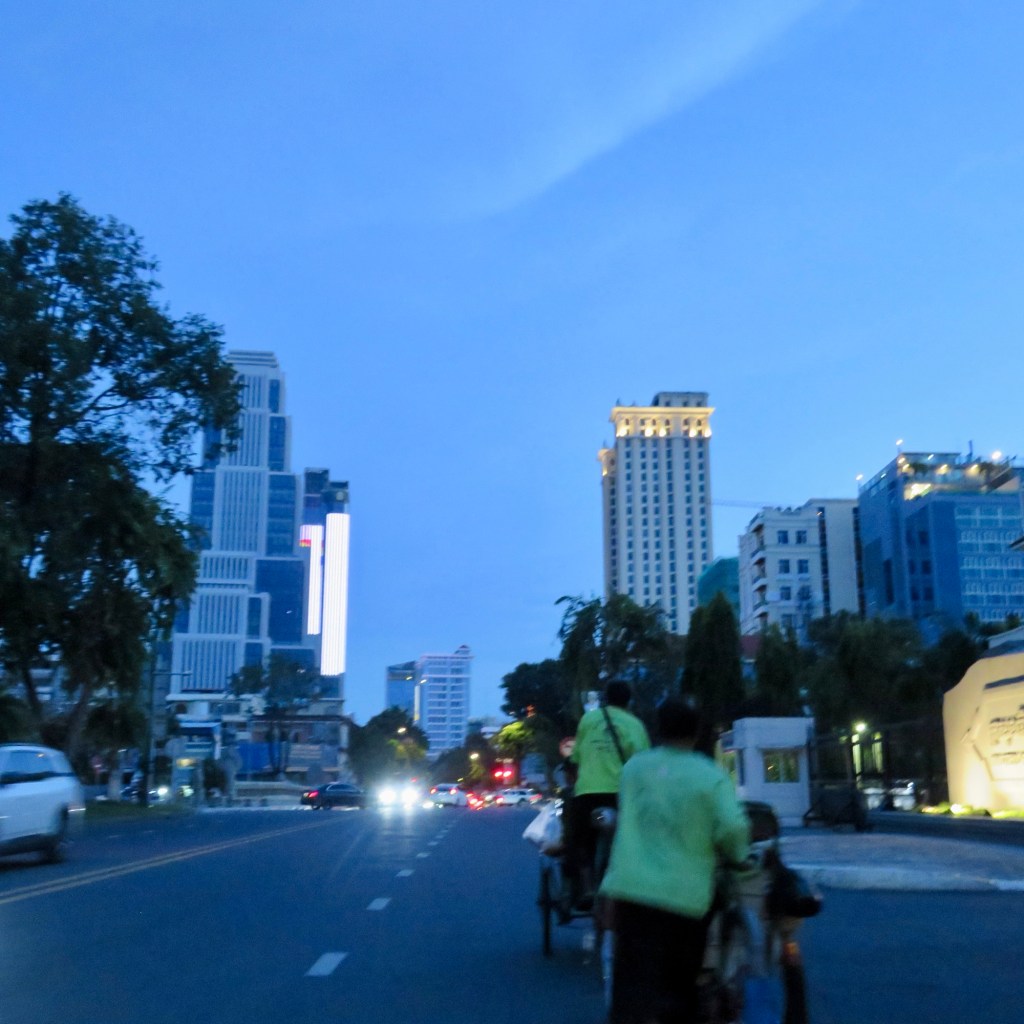
I began to think the economic revolution that was so much in evidence in Vietnam had passed Cambodia by. But the closer we got to Phnom Penh, the less that seemed to be the case. While much smaller than Hanoi or Saigon, Phnom Penh boasts some impressive skyscrapers. I’m told this is all very recent, and mostly due to Chinese investment.
Some of the modern skyline in Phnom Penh
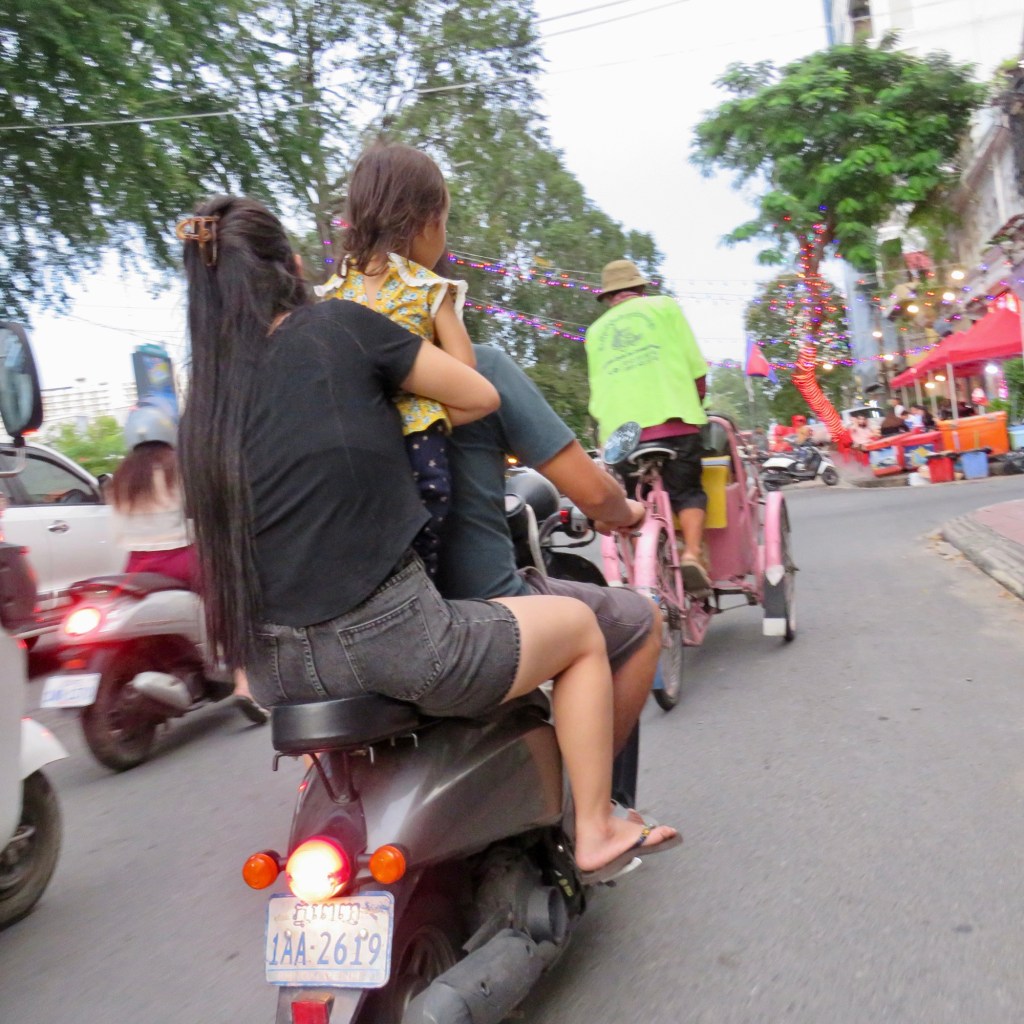
We settled into our hotel, and did our best to relax while we waited for our cyclo tour of the city. Adele is really starting to feel this cold we’ve both been fighting. About half our group are coughing and sniffing and sneezing. For Adele, I think it’s mainly draining her energy.
A scooter bearing three people, including a toddler, passes between the cyclos
Still, we went on the cyclo tour, and for dinner afterwards. Then back to the hotel slightly earlier than we might have if we were both healthy. We took a tuk-tuk with another couple who also wanted to come back a bit earlier. Hopefully a good night’s sleep will help.
It’s morning, and we’re on the bus to the Cambodian border. I’m a bit sad to be leaving Vietnam. I’ve got used to the heat and humidity, the crazy traffic in the cities, the wildly high numbers on the currency, being hustled just about everywhere we go — to buy a bag, get a massage, you name it.
Vietnam has defied every expectation of what a communist country would be like. It isn’t dour or repressive. Everything is lively, in fact, and at least at first glance, people seem to be happy, by and large. Or maybe “resilient” is a better word, and a little bit defiant. The Vietnamese seem to prize peace and independence, but they want them both. If they can only have one, I suspect they would choose independence. That’s admirable, and something I wish were more prevalent in Canada.
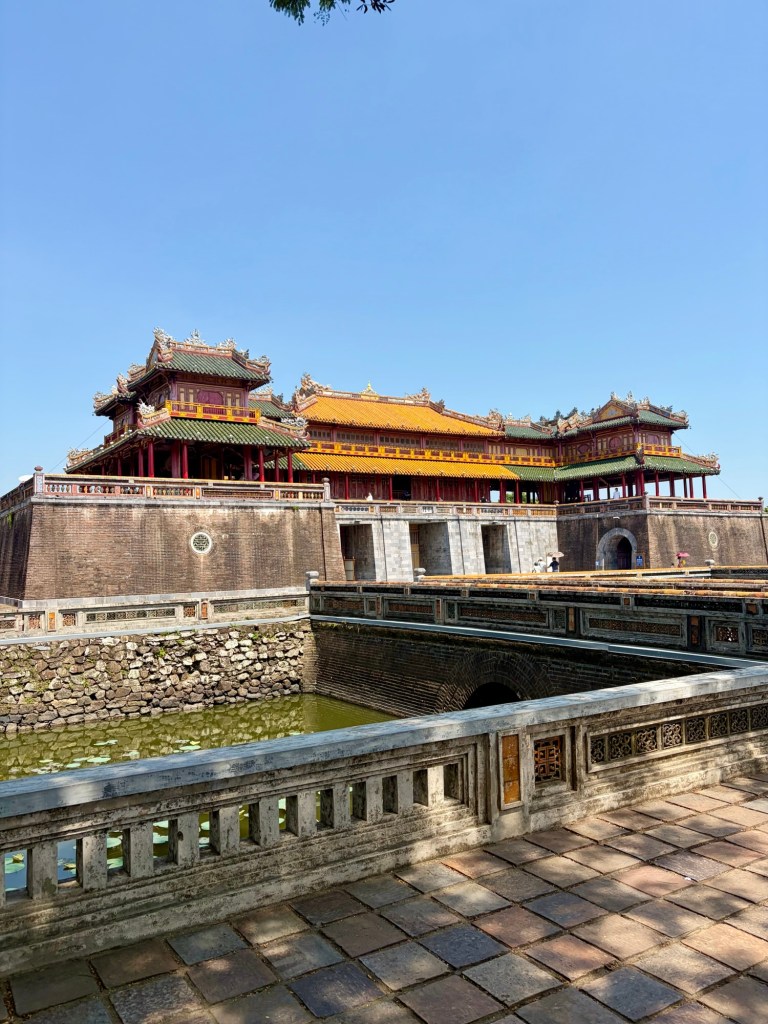
The Citadel in Hué
The food in Vietnam has been amazing, and very different from the Vietnamese food back home in Vancouver. I am going to have to try to find someplace that makes decent bun bo Hué, if I can. Or my quang noodles. Or pho that compares with what we’ve had here.
I haven’t really mentioned the beers here, which have all been good. I’ve had Tiger beer, Hanoi lager, Huda, LaRue, Saigon lager and 333 Pilsner. I highly recommend them all. And they’re cheap as chips, too — usually about 30,000 to 50,000 dong ($1.65 to $2.75 CAD), about the same as a can of Coke.
Leaving a city of 14 million people (which interestingly doesn’t feel overcrowded) that boasts some 9 million scooters, I’m tempted to look into one for myself. It probably won’t work in Vancouver, though, as traffic generally moves faster back home, and there are no separated motorbike lanes on the highway.
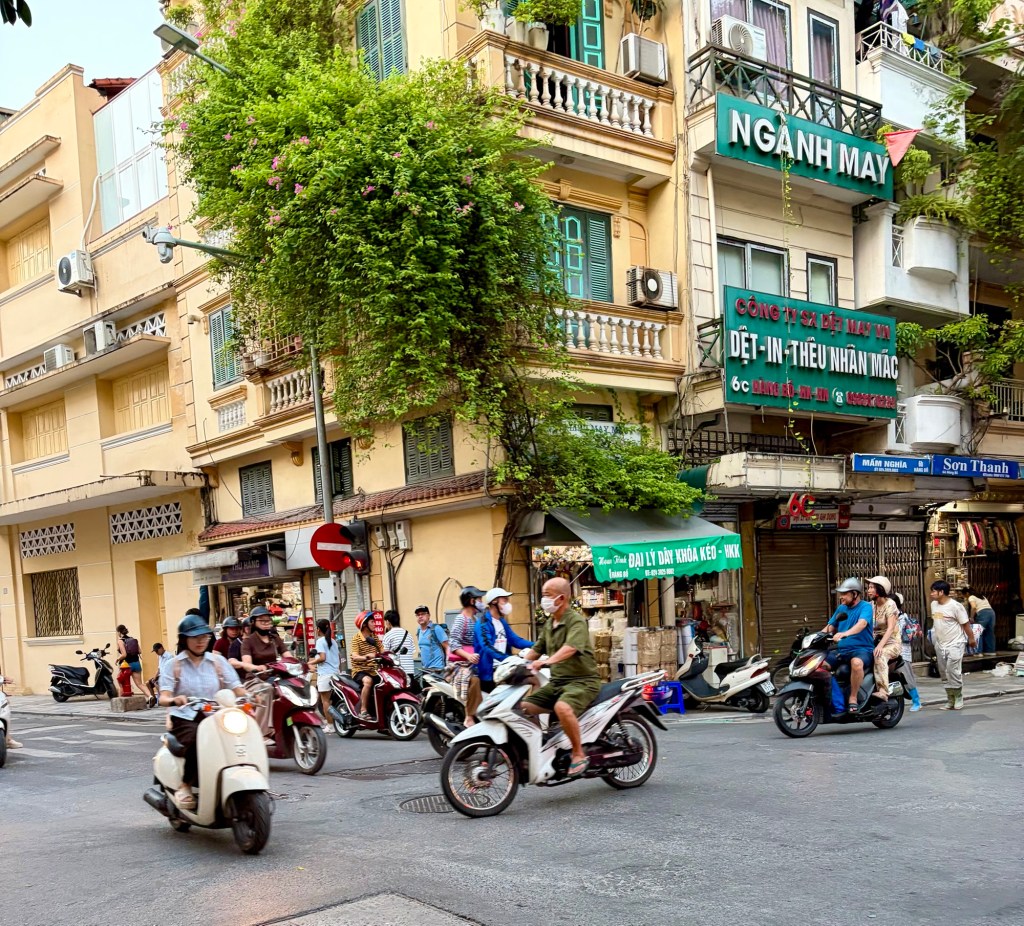
A quiet intersection in Hanoi
There have been things I haven’t liked as much, things that tend to be common in so-called developing countries. I miss being able to drink tap water. It’s a pain having to buy so much bottled water everywhere, and to need it even to brush your teeth. It’s disappointing to see garbage piled along riverbanks. But these are things that will change over time. Vietnam has only known peace for a little more than 30 years, and a market economy for even less. And in a one-party system, with no free press to speak of, it’s difficult to hold anyone in power accountable for such things. Mind you, it’s not easy even in a democracy like Canada.
Some of the highlights of our trip so far, aside from the character of the people, the quality of the food, and the price of the beer:
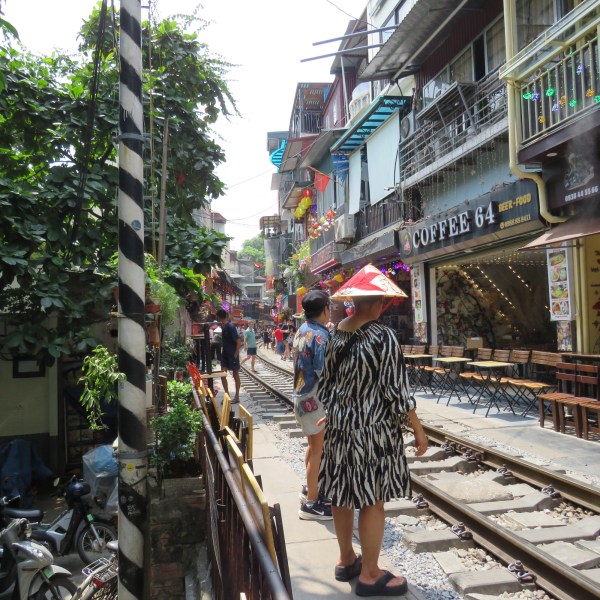
The Train Street in Hanoi
The serene beauty of Halong Bay
The Citadel and royal tombs in Hué
The Old Town in Hoi An (a UNESCO World Heritage Site)
Learning how to make rice noodles at Oodles of Noodles
Karaoke in the Tiger Tiger Bar in Hoi An
The emotionally devastating exhibits at the War Remnants Museum in Saigon
The Cu Chi Tunnels
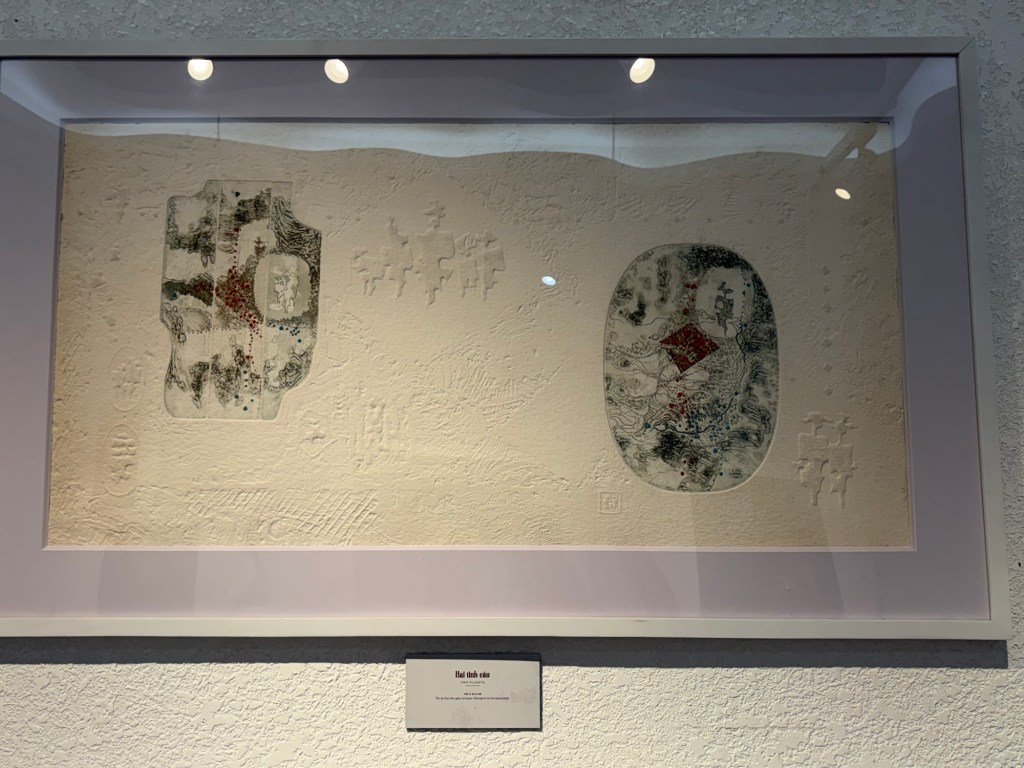
The Ho Chi Minh City Art Museum
Our tour of the Mekong River Delta
The markets in every city we’ve been to so far
If I were to come back, I’d try to spend more time everywhere, and maybe visit places we didn’t get to. It would be worth doing.
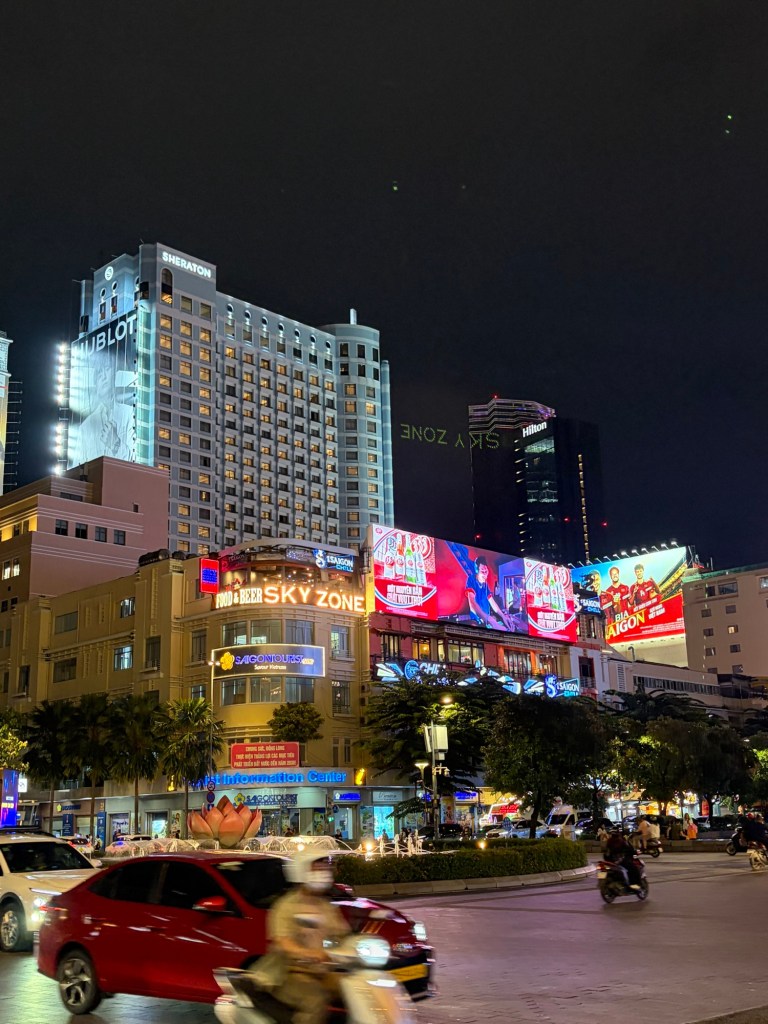
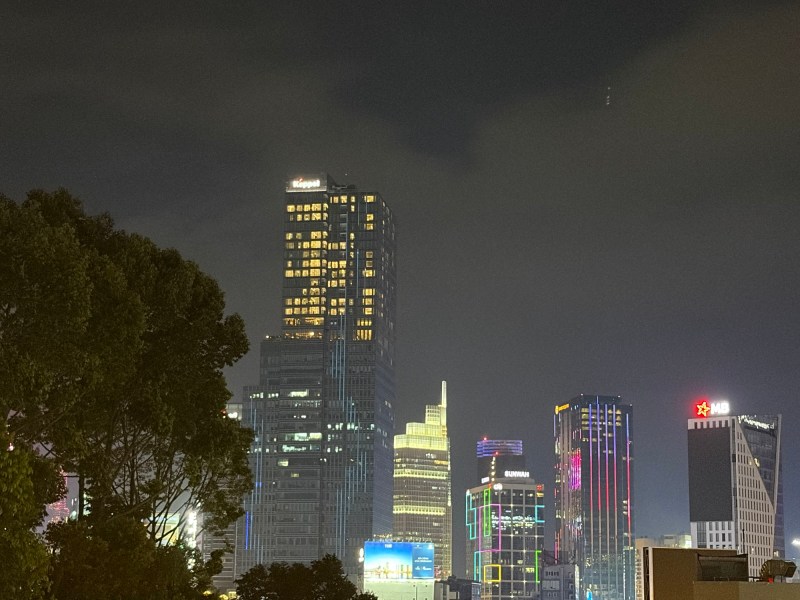
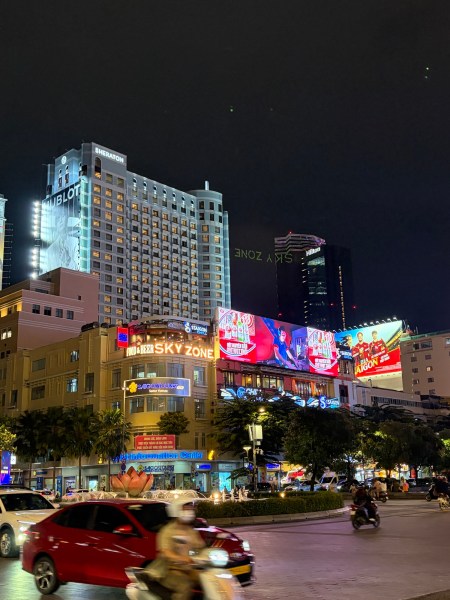
Saigon after dark
But soon we will be in Cambodia. I’ll writ more then.
Our newly amalgamated group — farewell to the Aussies, hello to a handful of Brits — assembled early in the lobby to set off for the Mekong River Delta. First, though, we had to pick up another G Adventures group to share the day with us. I have to admit I was slightly disappointed, as I’d hoped we’d have two seats each to ourselves so we could be less cramped. But no such luck.
It’s about a two, two-and-a-half hour drive from Saigon to My Tho, where our boat and local guide awaited us. It was a largely uneventful, if not super comfortable drive.
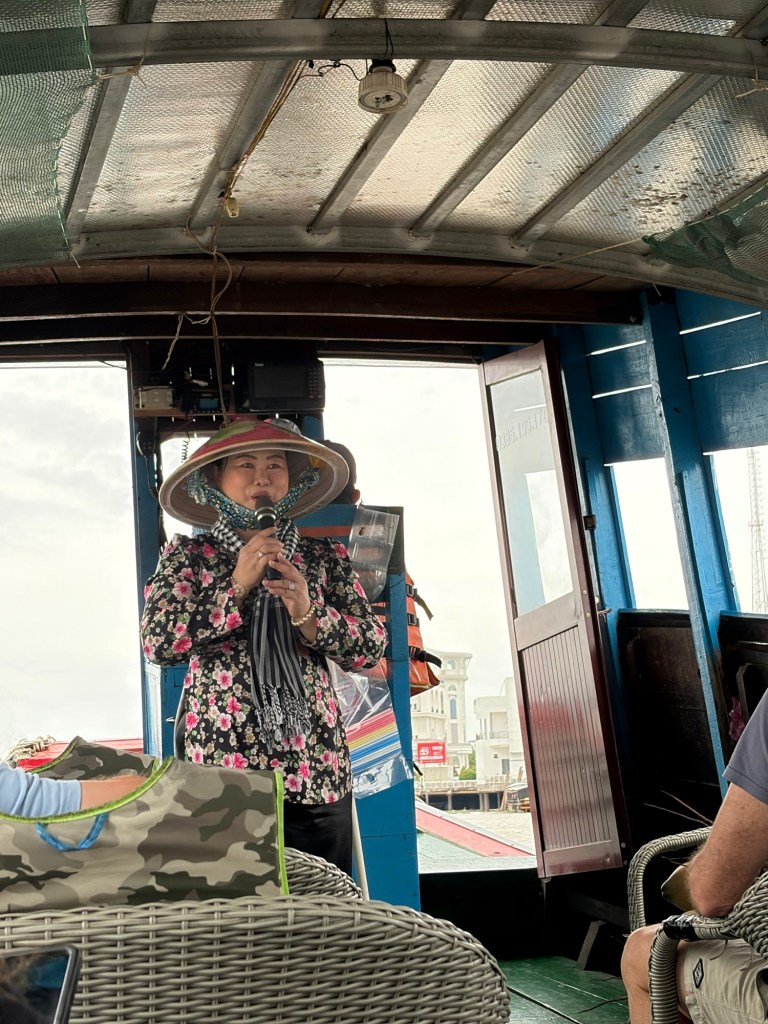
Our guide’s name was Yang, just like our CEO, although it happily didn’t create any confusion. We boarded the covered wooden boat and set off through the murky Mekong water toward Unicorn Island. Our first stop was to an apiary, where Adele finally succumbed to my exhortation and held up a rack of bees from one of the hives. After the photo, we drank honeyed tea and listened to a sales pitch about the wondrous benefits of royal jelly.
Our local guide, Yang
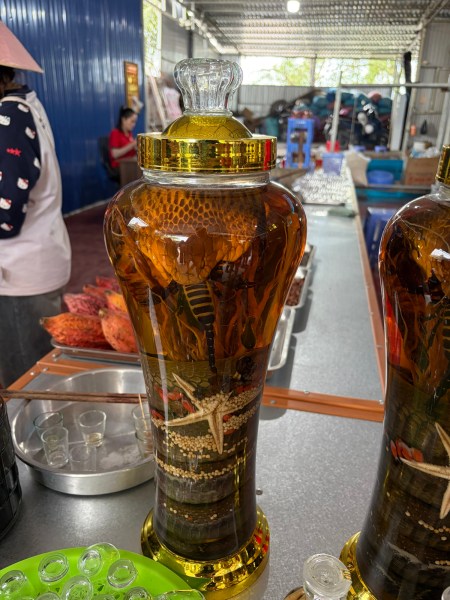
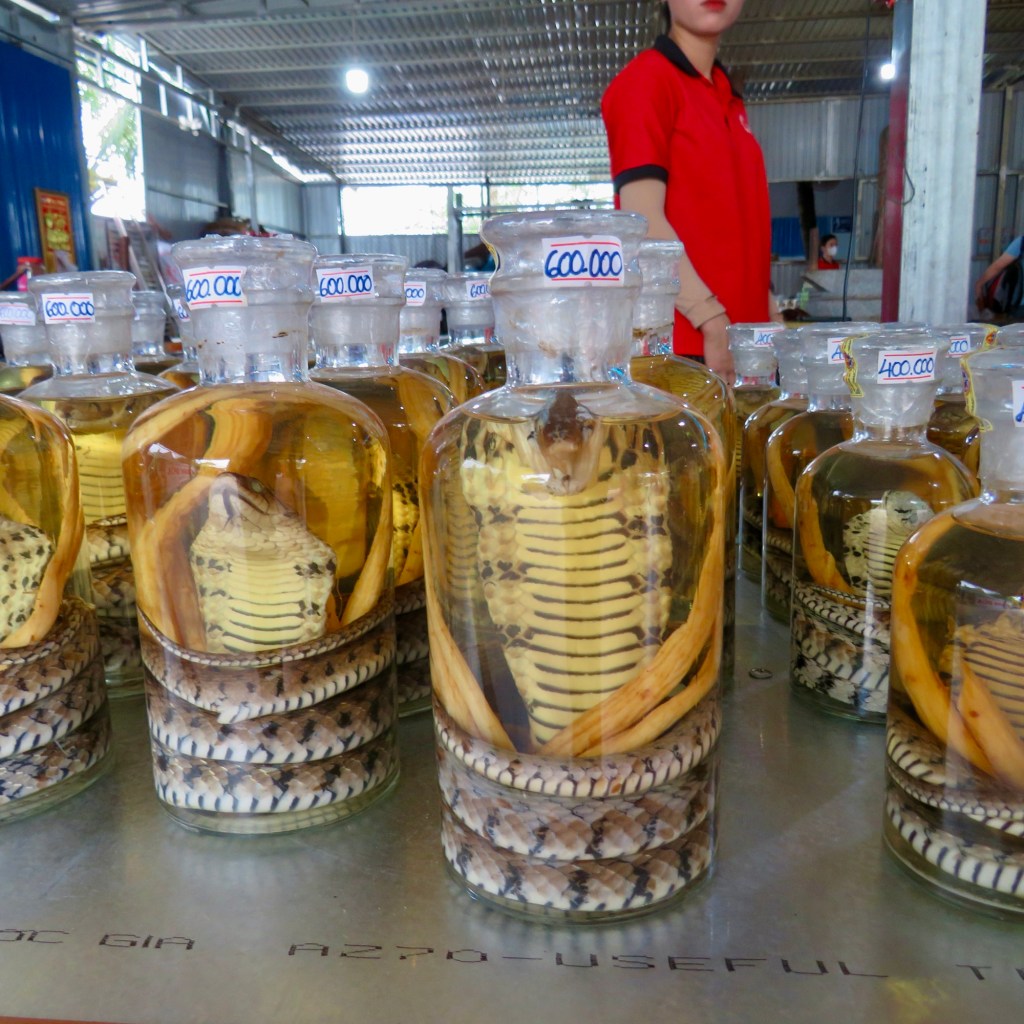
After that, we walked along a lane to a demonstration of rice popping, and a table selling snake wine, which smells a lot like tequila or mezcal, but was very smooth and nondescript — although the bottle was something else.
Real (dead) cobras steeping in “snake wine”
We stopped to sample some local, tropical fruit — guava, dragonfruit, pineapple, small bananas — and listen to a performance of some traditional Mekong music. It was almost bluesy at times, although the guitar’s frets were so severely scalloped that bending notes would be almost unthinkable.
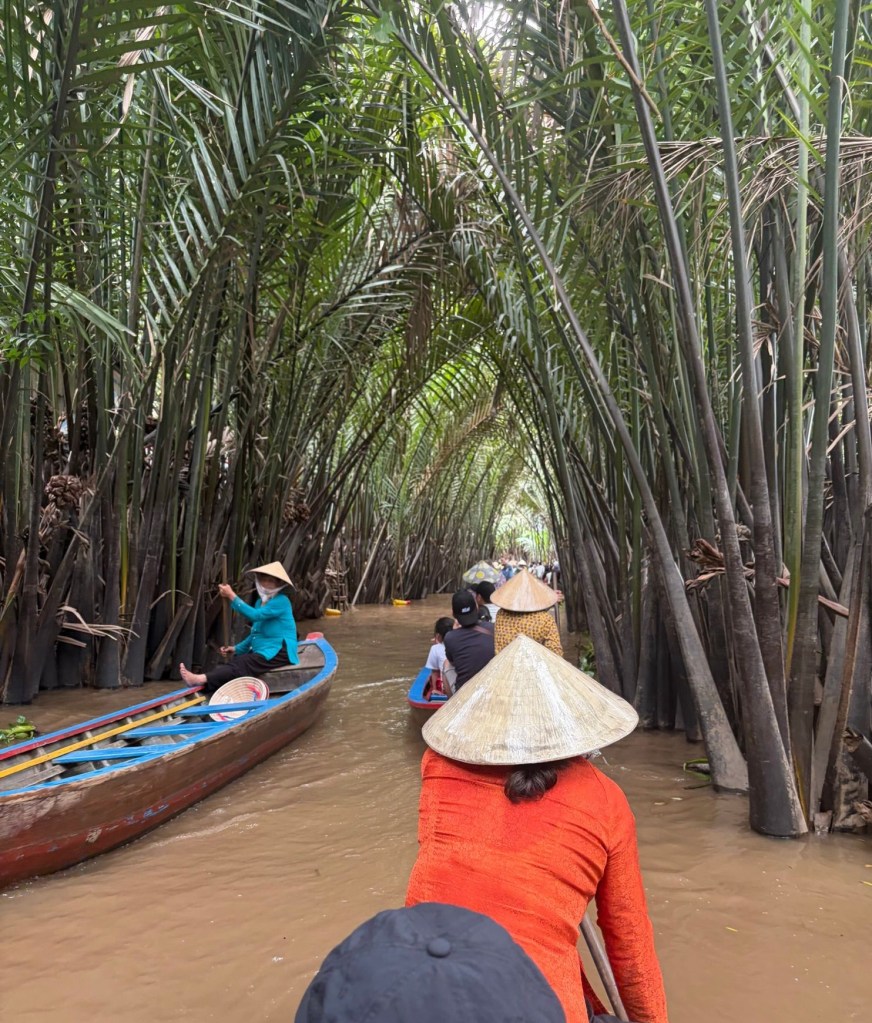
We then boarded small canoe-like row boats to be transported along canals beneath a canopy of water coconuts. It was quite serene, if you ignored the dozen or so other similar vessels plying the same waters.
Paddling through the canals
Back on the larger boat, then, and off to coconut island, where we learned more than I would ever have thought to ask about coconuts, went on a tuk-tuk ride around the small island, and had lunch. Then we took the boat back to My Tho and boarded the bus back to Saigon.
Other than the discomforts of the bus, it was a great last day in Ho Chi Minh City — and Vietnam. Tomorrow we’re off, bright and early, to Cambodia, where more adventures await.
The rain had stopped by the time we went downstairs for breakfast. There were no hints at flooding, and the forecast was mostly dry, especially in the morning.
We’re staying at the Jovia Hotel in a central part of Ho Chi Minh City. It’s definitely the most modest of our accommodations on this trip, with the exception of the overnight train from Hanoi to Hué. Coming after the exceptional hotels in Hué and Hoi An, it’s a bit of a letdown.
The bed is comfortable enough, the A/C works, and the shower is decent, but the room feels small, and poorly laid out. The breakfast, too, is the least impressive of any we’ve had so far. But there are eggs, baguettes and pho, so I won’t complain (too much).
We set off early today for our tour of the Cu Chi tunnels, which the North Vietnamese Army (known in the West as the Viet Cong) used to move undetected through the forest on the outskirts of Saigon. We had another excellent guide (all our local guides have been excellent), named Hung. “Hung Over,” he said; “so whenever you are recovering from too much drinking, you can think of me!”
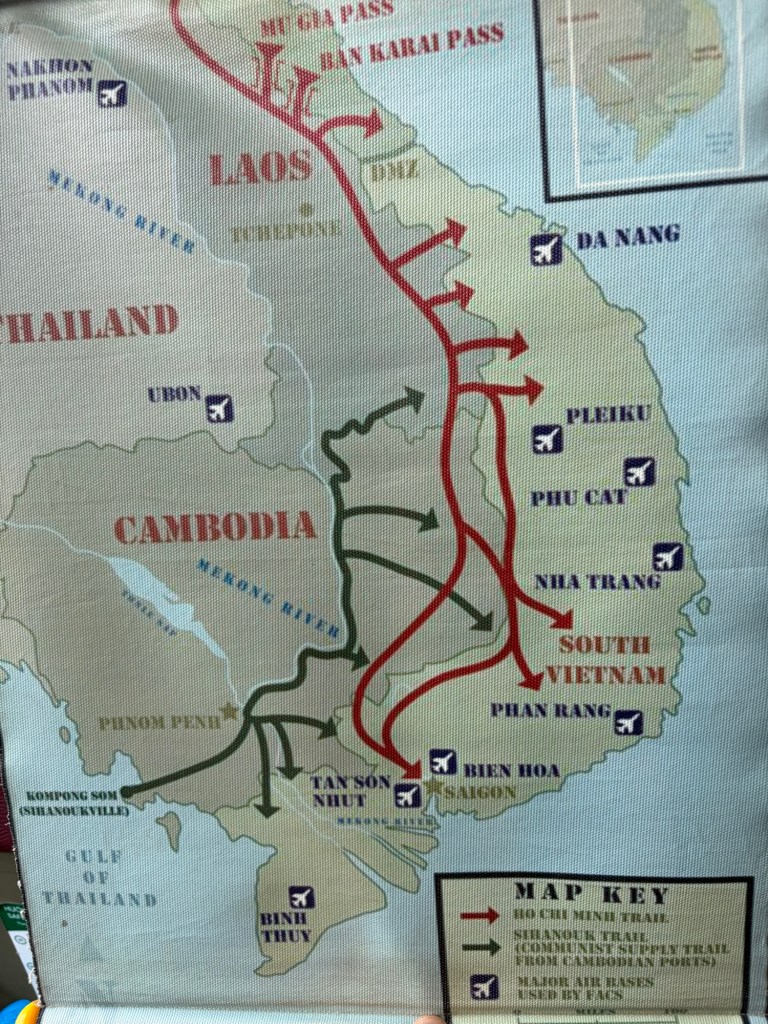
With cloth maps he unrolled like ancient scrolls, he walked us through the history of the wars between first the French and then the Americans as we rolled through the city and its suburbs. He explained, with visual aids, the Ho Chi Minh Trail. He talked about the division of the country into North and South. He detailed some of the guerrilla tactics used by the NVA, and how many families had sons and daughters fighting on both sides of the conflict.
Map outlining the Ho Chi Minh Trail.
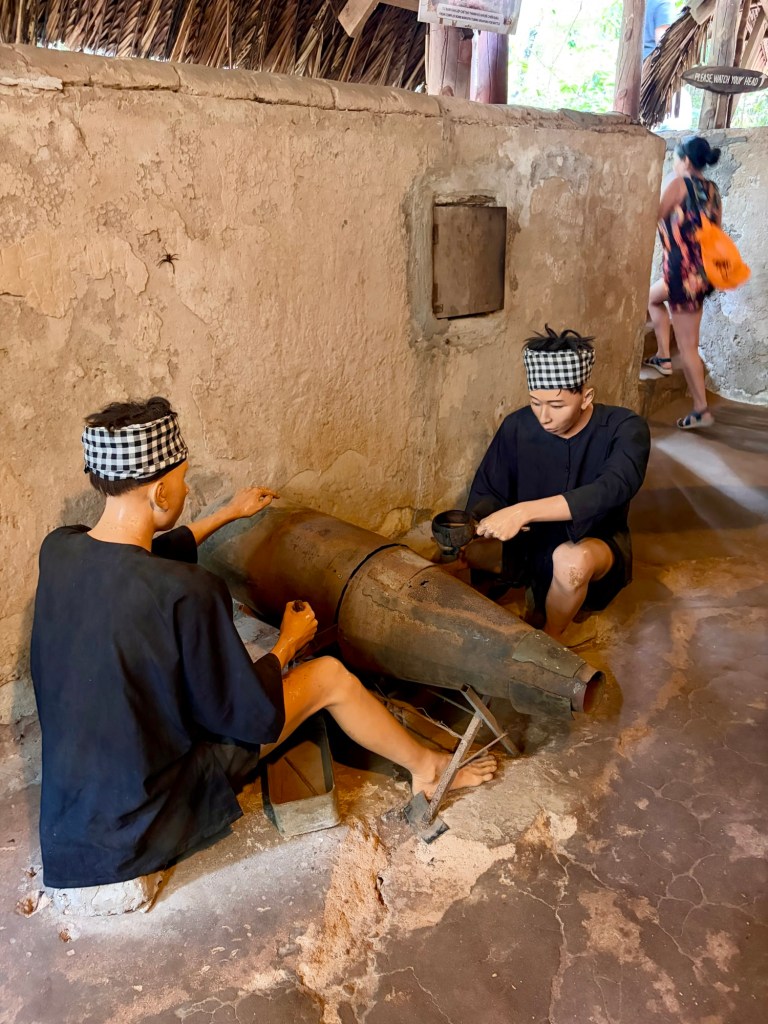
When we arrived at the Cu Chi tunnels, Hung led us along trails through the trees, stopping at various exhibits of how the tunnels were constructed, and what people did inside them: such as taking apart unexploded shells and bombs to redeploy them as land mines.
Two men use a saw to disassemble an unexploded bomb
Of course, many of the shells and bombs did explode, and there numerous craters marked as being the result of B52 runs, some of the as much as four metres deep, and 20 metres in diameter.
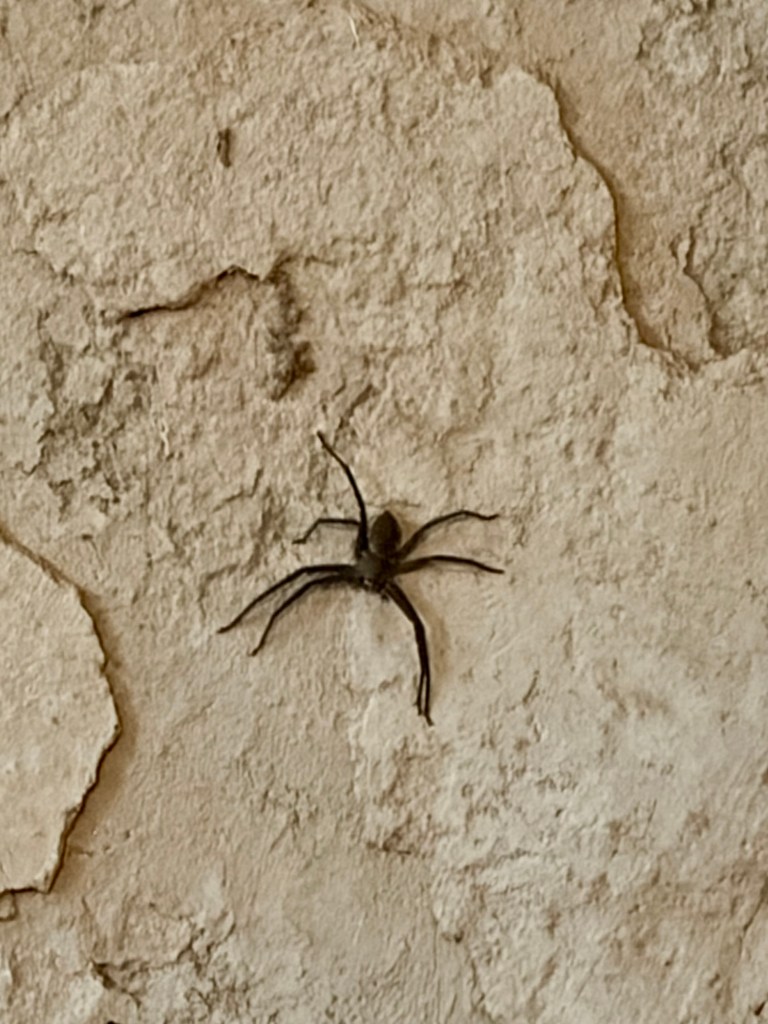
The exhibits are all outdoors or underground, which means a higher-than-average chance of encountering bugs and spiders. and we came across a centipede, a very large spider, and a scorpion along the way.
I named this spider — whose body was easily 3 cm long — “Stanley”, for no particular reason
There were opportunities to go down into the tunnels at different points, but I didn’t feel like crawling in a cramped, dark space, especially in this humidity. There was also a firing range where you could shoot an M16 or an AK47. But I’ve done that before in Las Vegas, and I didn’t feel the need to do it again.
After the tour we dropped off a couple of our tour mates at the airport. They are travelling together, and one’s visa expired early, so they left early for Cambodia. We’ll meet up with them again in a couple of days.
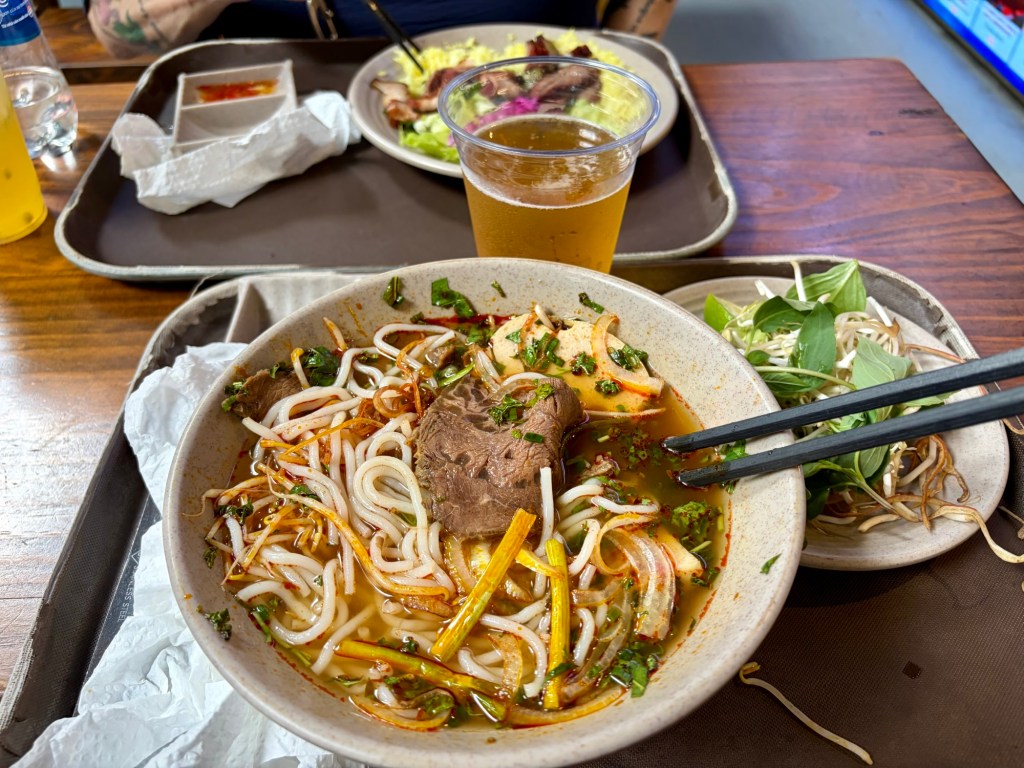
We went to a street food market not far from the hotel, where I had an excellent Bún bò Huế, a beer and a Kumquat juice.
Bún bò Huế might be my new favourite soup
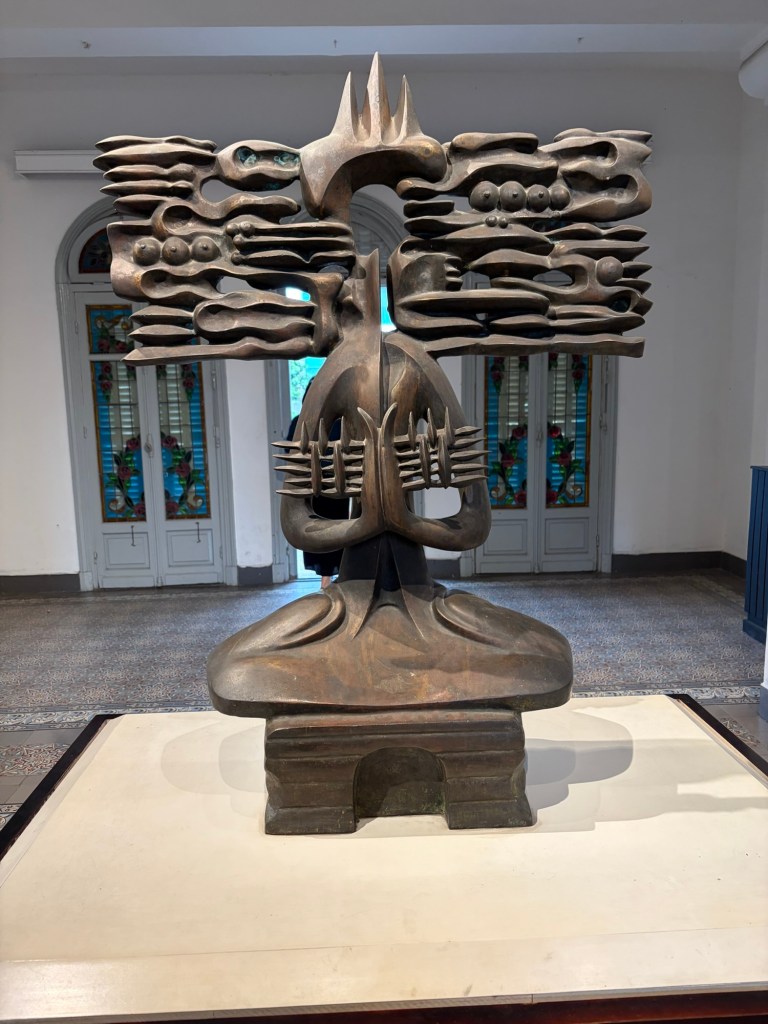
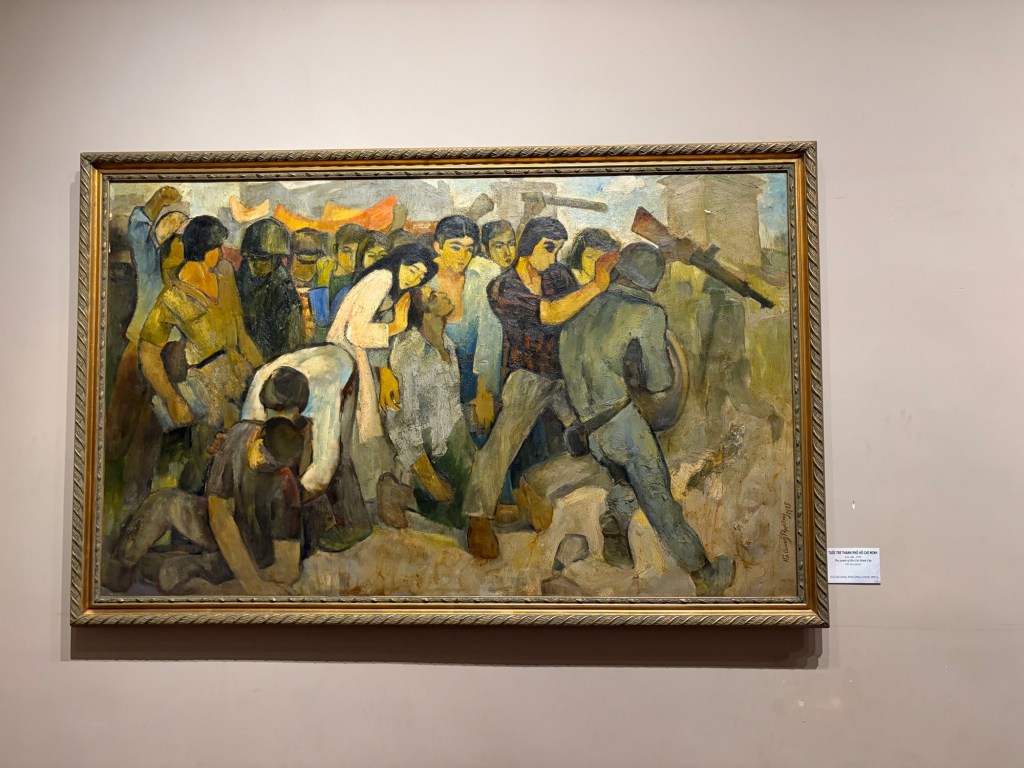
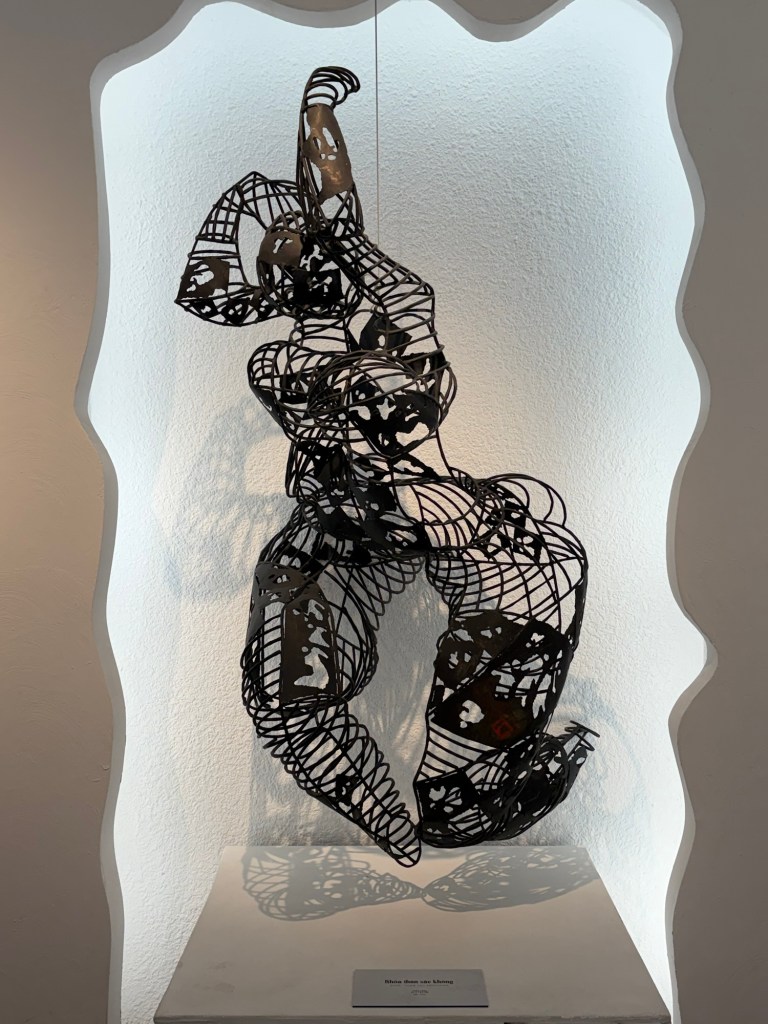
Later in the afternoon, Adele and I walked to the Ho Chi Minh City Art Museum, which is filled with incredible paintings and sculptures.
The museum’s only open until five, and at quarter to they started sounding alarms. By the time we got down to the entrance, at ten to, they’d started switching off the lights.
The rain had resumed while we were in the museum, and we thought about ordering a Grab, but the app said it would be 27 minutes, so we decided it made more sense to walk back. The museum is only a ten-minute walk from the hotel.
Later, after the rain stopped again, we met up with the others in our group for dinner and, to say farewell to those who aren’t continuing on to Cambodia with us, and hello who are joining us just for that leg of our journey. Then walked home to the hotel, admiring the city lights along the way.
Tomorrow we are off for a full-day excursion cruising around the Mekong River Delta. This is something I’ve really been looking forward to since we first booked the tour.
We were up early, breakfasted, and on the bus to the airport shortly after seven. The rain fell steadily through the night, and was still coming down in sheets as our bus pulled away from the hotel. I hope the rains will ease in Hoi An, and that they avoid the flooding they saw last year, where the waters in the Old Town were nearly two metres deep. I really like Hoi An, and I would have liked to stay longer. Maybe we’ll be back some day.
We got to the airport in plenty of time, even without the flight being delayed by half an hour. The Danang airport, though, is not a bad place to have to wait around. There are so many food options, from Burger King to banh mi, French pastries, Vietnamese coffee, and more. Add to that souvenir shops, jewellers, a bank — and all this in the domestic terminal, after security. Vancouver could learn a thing or two about airports from Vietnam.
Boarding was smooth, once it started, and the flight was uneventful, other than some turbulence. The airport in Saigon (or Ho Chi Minh City, as it’s officially known) is not nearly as impressive as Danang’s. At least, the arrivals area isn’t. But our bags were delivered much more promptly than in Hanoi, and we arrived at our hotel in the city about a half hour later than initially planned. Too early to check in, so we stowed our bags and went for lunch.
Walking through the streets near our hotel, you’d never know that just yesterday the city was flooded after a heavy rain. Thigh-high water rushed through the streets, although it apparently didn’t deter the scooter riders. I guess there’s not much you can do when the rains and flood waters come so suddenly. But today, the streets were dry, and the air was warm and heavy with humidity, although still not as uncomfortable as it had been a week ago in the north of the country.
We went to Pho 2000, apparently one of the better noodle houses in the city. It was perfect for me, as I hadn’t had pho at breakfast, and have started to feel like I’m fighting something off. The broth was just what I needed.
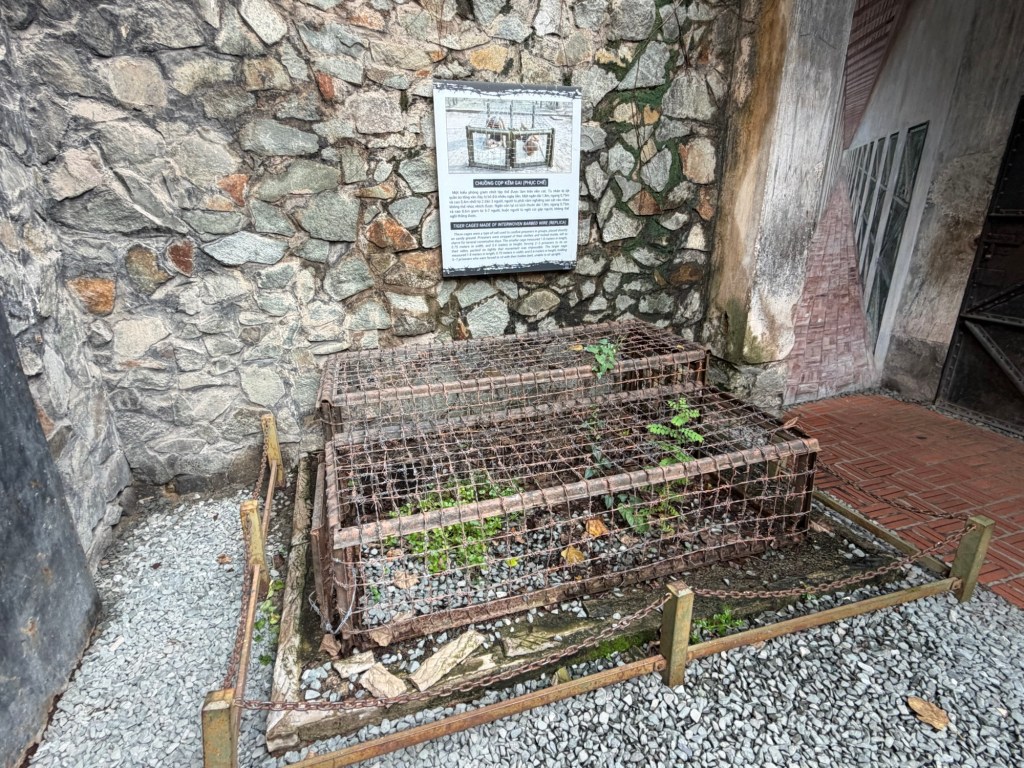
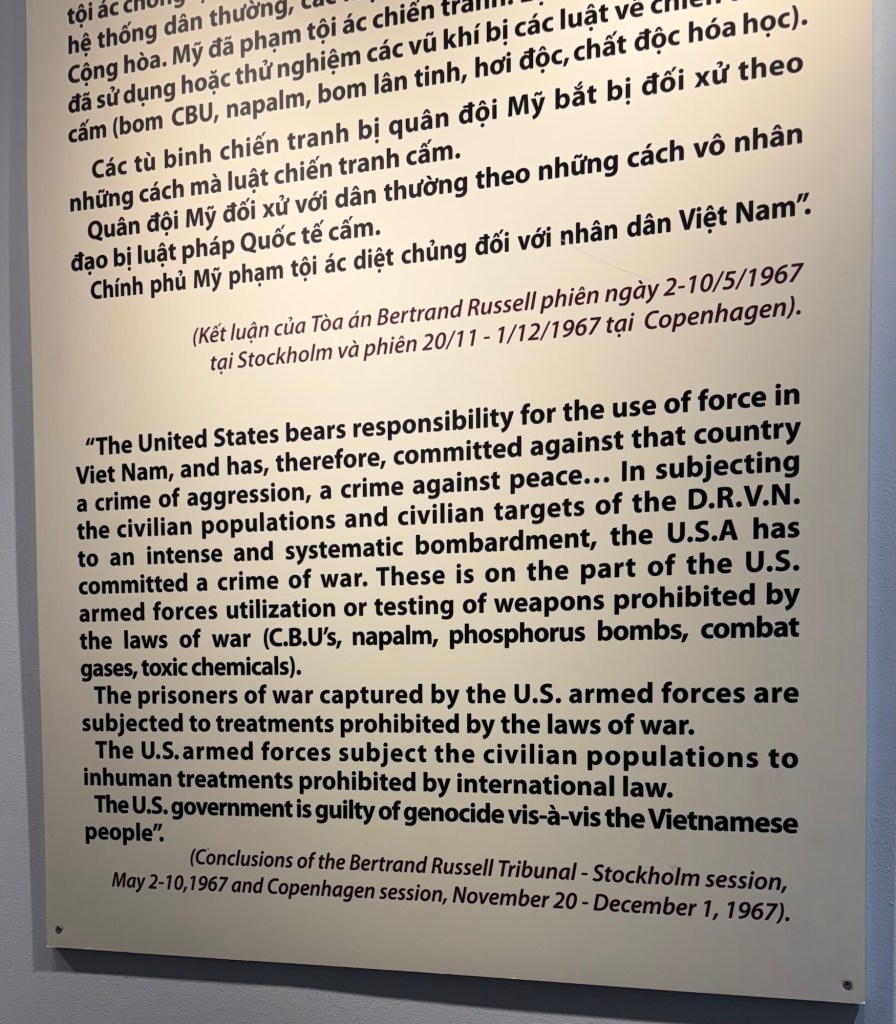
After we checked in at the hotel, we set out on a group tour of the city that Yang arranged for us. We started at the War Remnants Museum, which was emotionally devastating. The absolute horror that this country was subjected to is beyond anything the most anti-war film could hope to convey. Walking out of the exhibit about the victims of Agent Orange poisonings, I was literally in tears. No oppression, real or imagined, on the part of the communists can possibly justify what was done to innocent people, ostensibly to save them from said oppression.
Metal cages like this were used to house – and torture – prisoners of war
I’m glad Canada didn’t participate in the American-Vietnam war, but I wish we’d been more active in trying to stop it. I feel the same way about the American wars in Iraq and Iran, and the Israeli war against the Palestinian people. I’m glad we’re doing something, at least, to support Ukraine in their resistance against Russian aggression. We arguably should do more.
If only democratic governments, particularly in the West, had been as clear about what they saw happening in Vietnam as the English philosopher Bertrand Russell. If only they were so clear about more current atrocities.
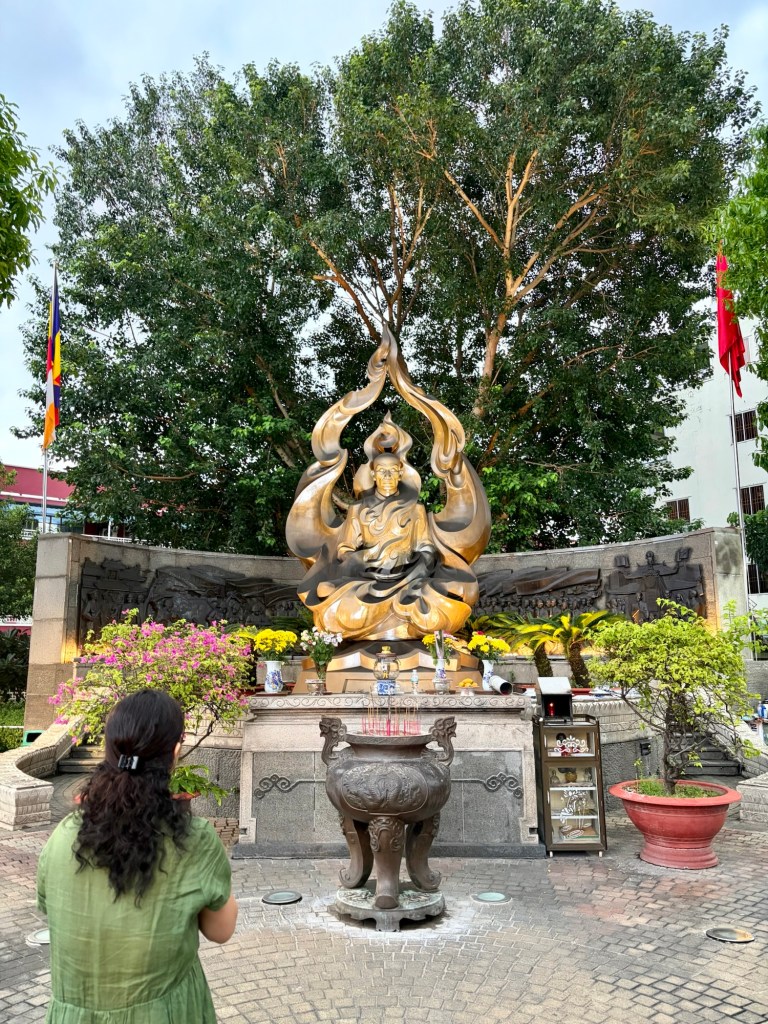
Our next stop was the intersection where the Buddhist monk, Thich Quàng Ðúc immolated himself in 1963. The government has erected a monument to him, and the inspiration of that was a good antidote to the horrors documented at the War Remnants Museum.
A young woman prays at the statue of Thich Quàng Ðúc
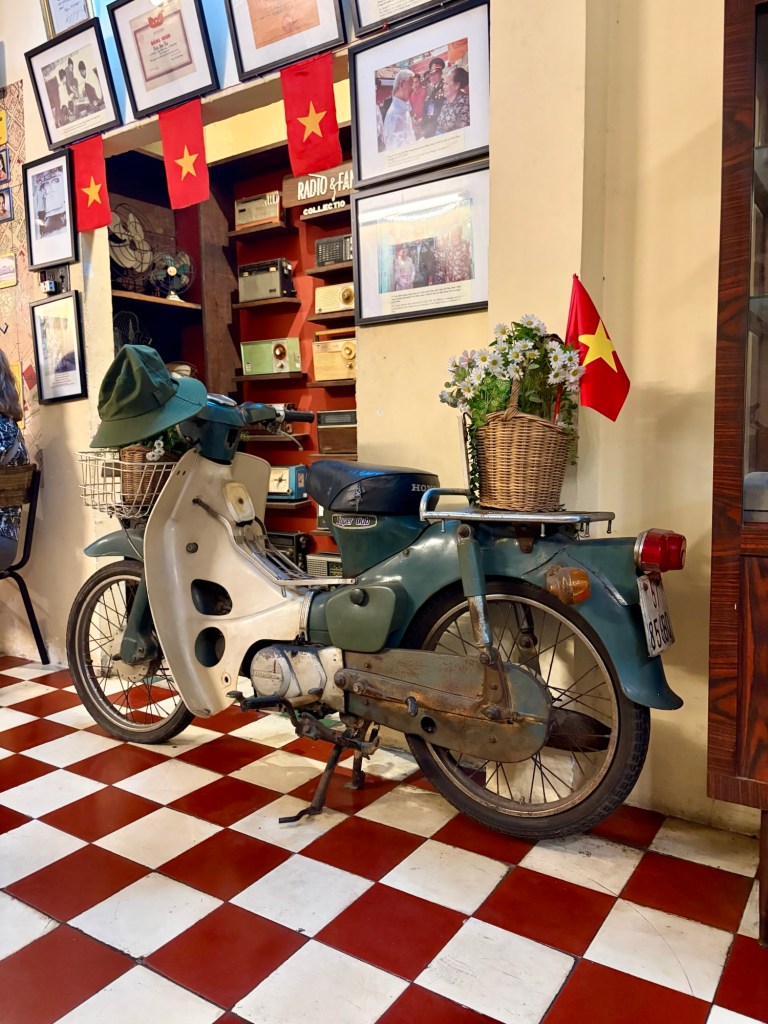
From there we visited the site of an underground bunker used to hide weapons and soldiers for the North Vietnamese army. The bunker went undiscovered through to the end of the war, even though many of the agents who ran it were arrested on multiple occasions.
An old motorcycle on display at the site of the bunker
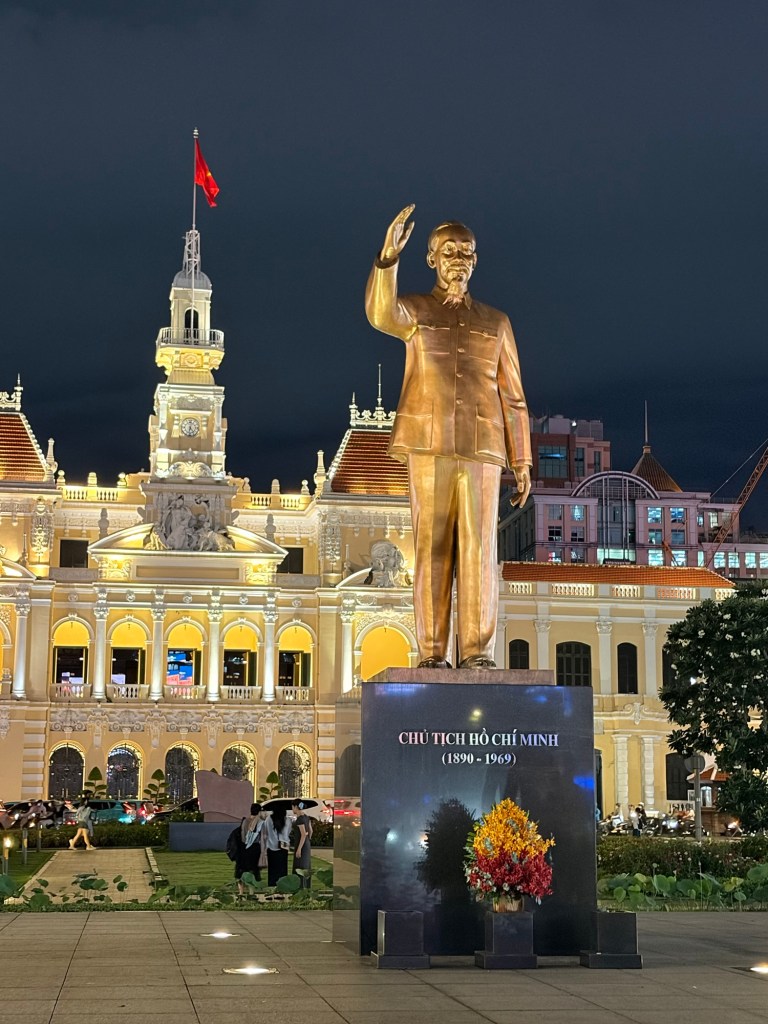
We moved on to other sites, including the Independence Convention Centre, formerly the Presidential Palace in the days of the days of the Republic of Vietnam; Notre Dame Cathedral — in the process of being restored, just like its namesake in Paris; the Central Post Office, with its prominent portrait of Ho Chi Minh and columns named after scientists; and the “city hall” for Saigon: the People’s Committee of Ho Chi Minh City building, with a gleaming, golden statue of Uncle Ho that instagrammers pose in front of. It is surrounded by high-end retail shops: Fendi, Rolex,Chanel. I wonder if this is what the revolutionaries had in mind when they were hiding in that bunker?
Ho Chi Minh saluting the future of Vietnam as a capitalist — oops, I mean communist paradise
By the end of the tour, we were feeling pretty done. We popped into the 7-11 across from the hotel to get some water, some junk food, and a Japanese-style egg salad sandwich. (It really is pretty damned good!)
The rains have since returned, hopefully not for long. There was a loud bang of thunder a short while ago. Let’s hope there’s no more flooding in store for Saigon this week.